Tuesday, June 7, 2011

PERCY COCKING IN COMIC CUTS (1922)

Recently, I had a chance to get two 1922 issues of Britain's pioneering comics magazine Comic Cuts from ebay (for an amazingly low price of app. 1 pounds each!). Comic Cuts, the first magazine to use the word "comic" in its title, was started by Alfred Harmswoth in 1890, and priced at 1/2 penny, half the price of similar magazines like Funny Folks, kicked off the boom of comics magazines in Britain. Above scan is of the cover of no. 1653 (dated Jan. 14th, 1922), featuring 'The Side-Splitting Adventures of Jolly Tom, the Merry Menagerie Man' by British comics artist Percy Cocking (1881-1964) who had been drawing the exploits of Tom in Comic Cuts since 1910. I find his art quite pleasing and high-calibre 'though the title character's twin nemesises are clearly modeled on Katzenjammer Kids. The back cover of this issue includes another strip by Cocking:

This strip is highly innovative in its utilization of the depiction of each flat as if a panel within the panels. Cocking's Mulberry Flattites had debutted in Comic Cuts in 1906. Cocking, a staffer for Harmsworth's Amalgamated Press (today's Fleetway), is better known as the artist who took over the hugely popular series 'Weary Willie and Tired Tim' created by the highly influential Tom Browne in 1896 for Illustrated Chips and continued it for more than four decades till the magazine folded in 1953.

Saturday, May 28, 2011

SKIT, SKAT AND THE CAPTAIN BY WILFRED HAUGHTON


Above scan is of a detail from the cover of no. 39 (dated Oct. 31st, 1939) of Britain's Mickey Mouse Weekly featuring the non-Disneyic comics characters Skit, Skat and the Captain created by the British comics artist Basil Reynolds for MMW alongside regular Disneyic characters in an illustration by MMW cover artist Wilfred Haugton. The full image of the cover is below:
Later in 1936, Haughton, who had been drawing the covers of MMW since its inception, also began a series titled 'The De(f)tective Agency!' featuring Goofy and Toby Tortoise as private detectives. Reynolds' characters made a cameo appearance in this series as well, in no. 50 (Jan. 16th, 1937):

Thursday, May 26, 2011

REYNOLDS' CAPTAIN IN YUGOSLAVIAN DISNEYIC COMICS (1936)


British comics artist Basil Reynolds' Captain character from his (non-Disneyic) 'Skit, Skat and the Captain' series which he drew for Britain's Mickey Mouse Weekly between 1936-1940 had made a cameo appearance in a Yugoslavian Mickey Mouse comics published in 1936: He appears in the 25th part (see above scan, taken from outducks archive) of the 'Donald & Mickey - A Trip: New Adventures' serialized in Mika Mis no.'s 32-56.
Reynolds' Captain's cameo in this Yugoslavian comics was first noticed by inducks indexer Mankkop in 2010. Actually, 'Donald & Mickey - A Trip: New Adventures', probably drawn by Yugoslavian comics artist Vlastimir Belkic, utilizes even more material from from MMW: For instance, the sea dragon which appears in part 4 is traced from a non-Disneyic gag, probably again the work of Reynolds, in MMW no. 4 and the tiger in part 19 from the 'Ted Towers' comics, of US origin, serialized in the early issues of MMW; I am sure that a patient examination would lead to identifying most of the figures in most of the panels to be traced from somewhere in MMW.

Tuesday, May 24, 2011

FIRST COLOR EDITION OF FELIX THE CAT IN TURKEY (1938)


'Felix the Cat', the biggest star of early American animation, had been adopted to the newspaper comics medium in 1923. Felix comics debutted in Turkey in the weekly children's magazine Yarutürk in 1936, retitled as 'Kara Kedi [the Black Cat]'. Published in monochrome on either the reverse of the back cover or on the back cover itself, the earliest Turkish editions of 'Kara Kedi' were reformatted with speech balloons deleted and text material added beneath the panels (scan of a sample from this period was earlier posted in this blog). 'Kara Kedi' appeared in this format in Yavrutürk till no. 125. When it resumed at the reverse of the back cover of no. 135 (dated Nov. 26th, 1938) with a new continuity titled 'Kara Kedi Gemici [Black Cat the Sailor]', it was not only in proper comics format with speech balloons and no text outside the panels, but also in color (see above scan), marking the first time a comics was published as such in Yavrutürk. Actually, I think this was the first time ever any comics was published both in color and in proper format in Turkey (there had been comics published in ull color since 1935, but they had extra-panel texts; and comics in proper format had been published since the same year, but they were in monochrome).
The first installement of 'Kara Kedi Gemici' had clearly been intended to be printed on the back cover itself, but shifted to the reverse side due to an editorial decision at the last moment to allocate the front cover to a photo of the cascet of the recently deceased Kemal Atatürk, the founder of the Turkish Republic, and shift the original front cover to the back cover. With the subsequent issue, 'Kara Kedi Gemici' took its place on the back cover:

Nevertheless, the series was shifted to interior pages with no. 143 and began to be printed in b&w, although still in proper comics format. Unfortunately, while earlier 'Kara Kedi' continuities often entailed fantasy elements and hence had very imaginative narratives, 'Kara Kedi Gemici' was a fun, but more routine affair, as exemplifed in the below cannibal sequence from no. 159:
'Kara Kedi Gemici' ended in no. 165 (dated June 24th, 1939). The subsequent four issues of Yavrutürk featured 'Kara Kedi' once again in the outmoded reformat of extra-panel texts to compansate for deleted speech balloons. Afterwards, no 'Kara Kedi' comics were published in Yavrutürk for more than two years. 'Kara Kedi' returned to Yavrutürk when the magazine started its vol. 12 with new enumeration on Oct. 25th, 1941 (previous 11 volumes had consequitive enumeration). Proper format with speech balloons and no extra-panel text was resumed with no. 28 (dated July 18th, 1942). When Yavrutürk was replaced with Çocuk Haftası from the same pulisher at the beginning of 1943, 'Kara Kedi' continued in this new childre's magazine.

Monday, May 23, 2011

OBSCURE RACIAL-STEREOTYPING COMICS


An obscure gag-a-week comics series based on degrading racial stereotyping of African blacks, titled in Turkish as 'Başkan Bambu [President Bamboo]', was ran in some issues of the Turkish weekly children's magazine Yavrutürk in 1938. Above scan is possibly of the first installement of the series (the issue no., as well as the date, are missing from the tattered copy in my collection, but it is probably no. 93). At the beginning of this gag, Bambu is introduced as "the most civilized president of the savages."
The presence of the ruling colonial forces is manifested in the below gag from no. 97:

Probably the most degrading portrayal is in the below gag from no. 98:

My Yavrutürk collection from 1938 is incomplete, but 'Başkan Bambu' was in most likelyhood published in less than ten issues.
If anyone knows the original source of this comics, please let us know...

OBSCURE TINTIN-LOOKALIKE COMICS


In 1940, an obscure adventure comics titled as 'Bücür Görünmeyen Şehirde [Shorty in the Invisible City]' was serialized in the Turkish children's weekly magazine Yavrutürk no.'s 198-208. The plot starts with a white kid who looks somewhat like Tintin, named as Bücür in this Turkish edition, befriending a native kid called Duda in Africa. The two kids come across a city in the desert where they are imprisoned for attempting to buy some food with money; for transactions with money has been forbidden in this city where everyone is obliged to give any money they find to the city's ruler. Bücür manages to escape and take a leading part in a revolt against the ruler. In the end, when he wants to embrace Duda, his friend disappears as a mirage! So does the city! In a twist, it all turns out to be a feverish dream...
If anyone knows anythig about the original source of this weird comics, PLEASE let us know..

Sunday, May 22, 2011

TURKISH DEBUT OF KATZENJAMMER KIDS


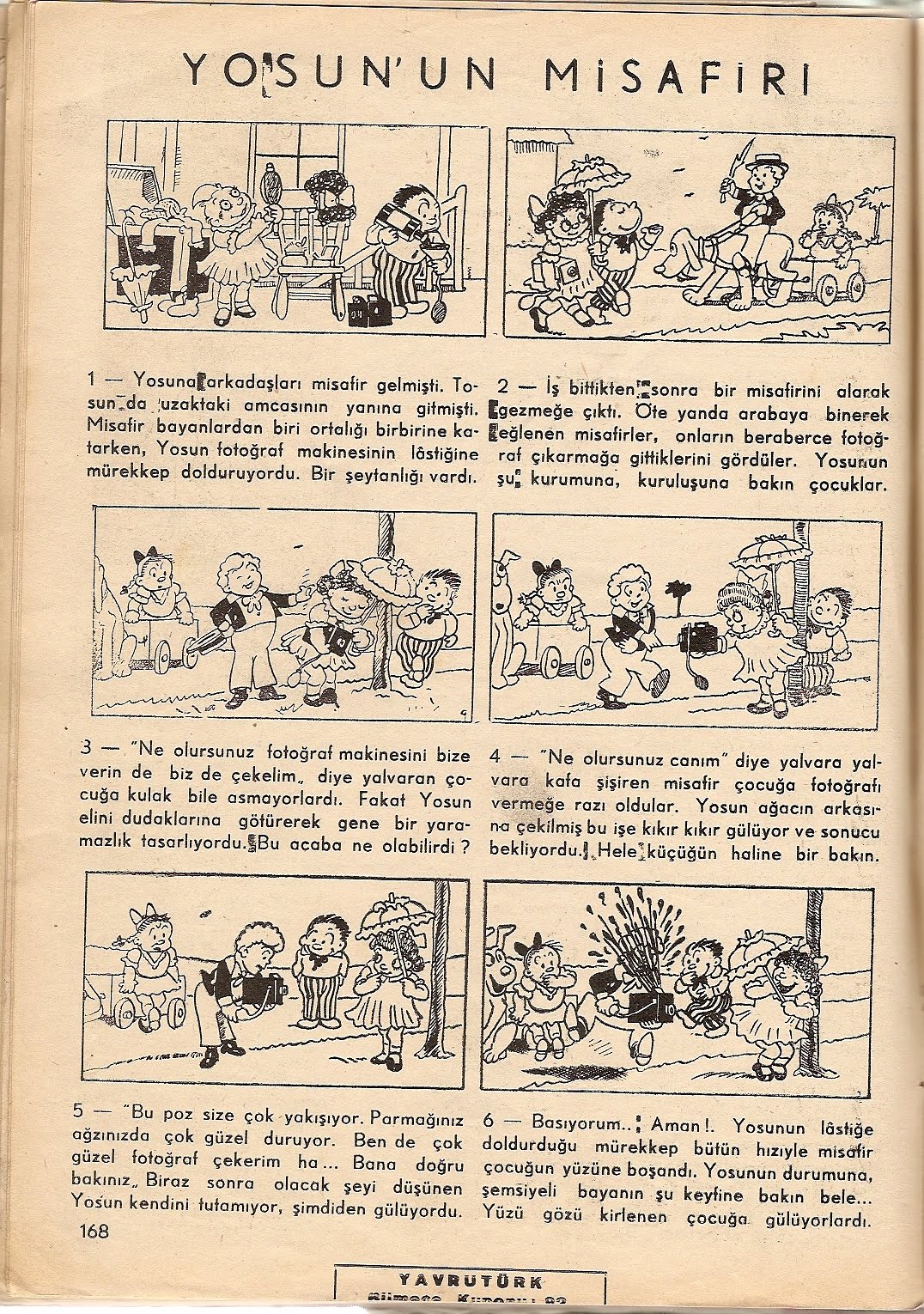
'The Katzenjammer Kids', considered by many as the first proper US comics strip, arrived in Turkey with almost a four decades delay. Above scan is of its Turkish debut in no. 66 (dated July 31st, 1937) of the weekly children's magazine Yavrutürk. Retitled as 'Tosunla Yosun [Tosun and Yosun]', the Turkish edition was traced in b&w with the speech balloons deleted from the panels and supplemented with extra-panel texts (the source of the Turkish edition might be French albums by Hachette which is known to have reprinted American strips in similar re-formatting) which is especially unfortunate as 'the Katzenjammer Kids' was one of the earliest strips to utilize speech balloons.
In 1914, 'the Katzenjammer Kids' had been cloned by its original artist Rudolph Dirks when he had lost the rights of the title to publisher Hearst in a court case: While Dirks featured the same main characters in a separate untitled strip, eventually titled as 'the Captain and the Kids', for the rival publisher Pulitzer, Hearst continued 'the Katzenjammer Kids' with a new artist, Harold Knerr. Both strips continued seperately for several decades (the Hearst version is still continuig today). The Turkish edition is of the Hearst/Knerr version as it features the supporting characters private tutor Miss Twiddle (referrred simply as "teacher" here) and her niece Lena (renamed as Fatoş and referred as the teacher's daughter), both of which were created by Knerr in 1936 and hence utilized only in the Hearst version. Yavrutürk no's 66-73 ran gag-a-week episodes of 'Tosunla Yosun', each gag being about the kids' mischiefs against their tutor and/or her niece. A five-part continuity titled as 'Tosunla Yosun Dünya Gezisinde [Tosun and Yosun in World Trip]' started in no. 74 with the kids embarking on a balloon voyage where they utilize a sea tortoise as their engine:
The second episode came in no. 76 (no 'Tosunla Yosun' page was published in no. 75, as well as in no. 77) when the kids steal away the food of a native who shoots down their balloon in revenge:
and chases them to an island:
On the island, the kids and another shipwreck rescue a baby ape:
and the island's apes help them in repairing their vehicle:
No 'Tosunla Yosun' pages were published in the next three issues of Yavrutürk after the end of this mini-adventure, but a stand-alone gag appeared in no: 84:
In 1938, several gag-a-week episodes featuring some child guests appeared, probably beginning with the below one from possibly no. 92 (the issue no. and date is missing from the tattered copy I have in my collection):
Further gag-a-week episodes with these new supporting characters appeared in no.'s 96, 97, 99 and 104 (my Yavrutürk collection from 1938 is incomplete, so a few more episodes might have been published); if anyone knows their original names, please let us know.
No 'Tosunla Yosun' pages were ran in Yavrutürk in 1939, but, inbetween three issues with color editions in back covers in 1940 (see below post in this blog), the below half-page appeared in no. 216 (dated June 1st, 1940):

FIRST COLOR EDITIONS OF THE KATZENJAMMER KIDS IN TURKEY (1940)


Above scan is of the back cover of no. 214 (dated June 1st, 1940) of the Turkish weekly children's magazine Yavrutürk, marking the first color edition of 'the Katzenjammer Kids' in Turkey. The back covers of no. 217 and 218 once again featured the Katzies, this time re-titled as 'Yosun ile Tosun ve Kaptan Baba [Yosun and Tosun with the Captain Daddy]', elevating the Captain to the title:


Saturday, May 21, 2011

KATZENJAMMER KIDS CLIPPINGS FROM 1902


These two Sunday newspaper comics clippings from 1902 (currently being offered on ebay) are the earliest samples of Rudolph Dirks' 'Katzenammer Kids' which I could find.
'Katzenammer Kids', which had debutted in 1897, is regarded as the first proper US comics (ie. structured as borderlined panels with speech balloons.

Friday, May 20, 2011

A HOODED NAZI GETS THE KICK (1943)


Miss Fury was one of the earliest masked heroines in comics - and the first one created by a female artist. June Tarpé Mills did not use her female-sounding first name when signing her work, but when Miss Fury, which debutted as a Sunday newspaper comics on April 6th, 1941, became a success, the true gender of her creater was eventually made public. Miss Fury's comics book series began in 1942 and lasted on a bi-/tri-annual period for 8 issues till 1945. You can view all the covers of this series here: http://www.comicvine.com/miss-fury-comics/49-20505/ (from which the above image was also pasted from); note that the covers of no. 4 and 5 feature evil Japanese, allies of Nazi Germany in the 2nd World War. Miss Fury comics series seem to be highly collectible items as all single issues available on ebay are offered for three- or four-digit figures!.. On the other hand, I could find one sample of the Sunday pages which indicate that the artwork was quite high-calibre:
Mills' comics work prior to 'Miss Fury' include the one-shot horror comics 'The Vampire' and the 'Daredevil Barry Flynn' series, both from Amazing Mystery Funnies*.
* Denis Gifford, The International Book of Comics (1988: W H Smith)

Tuesday, May 17, 2011

BUCK RYAN - THE ITALIAN REPRINTS

'Buck Ryan' was a detective strip published in the British newspaper Daily Mirror from 1937 onwards till 1962. During its heydays, there has been only a single one-shot Buck Ryan comics published in the UK (in 1946) and there was also an Australian Buck Ryan comics periodical. Other than what appears to be a fan-based reprint series from Newspaper Daily Comic Strip Library, there has not been any English-language reprints. However, there were some Buck Ryan albums published in Italy. The first one, in oblong format (see above image for cover) came in 1973; I don't know about its contents. Later in the same decade, the same publisher, Milano Libri Edizioni, also published a series of four albums, which appear to be hardcover editions, reprinting in chronological order from 1937 through 1940:


I've just ordered two issues of the British NDCSL reprint series and will post about them when I receive them.
Sources on the 1946 British one shot and the Australian comics: Denis Gifford, The Complete Catalogue of British Comics (1985: Webb & Bower, Exeter) and ibid, The International Book of Comics (1988: W H Smith) resp.

Tuesday, May 10, 2011

FIGHT COMICS


While researching for some other topic, I incidentally came across this startling World War 2 cover yesterday. It is no. 32 (dated June 1944) of Fight Comics published by Fiction House. Fight Comics had lasted for 86 issues between 1940-54. It was the second comics magazine put out by American publisher Fiction House who are better known with Jumbo which had featured Sheena, the first jungle girl hero in the comics medium.
Obviously encouraged by the popularity of Sheena, Fiction House had introduced a new jungle girl, named Tiger Girl, in Fight Comics no. 32 (hence the reason I went looking for this issue). Tiger Girl would also eventually be popular enough to grace the covers of most of the subsequent issues herself, one of my favorites being this later cover from no. 73 (dated March 1951):

Saturday, April 30, 2011

SKIT, SKAT AND CAPTAIN IN MICKEY MOUSE XMAS SPECIAL (1939)

One of the few excursions of Basil Reynolds' 'Skit, Skat and Captain' out of Mickey Mouse Weekly, where it had debutted (see the earlier post in this blog), would be the four Mickey Mouse holiday specials put out by the weekly's publisher Odham Press between 1936-39. The above scan is from the last of these publications, titled Mickey Mouse Xmas Special. Besides 'Skit, Skat and Captain', Reynolds also contributed two Disneyic strips to this christmas special.

MARMADUKE IN COLOR (1942) AND THE RETURN OF MARMADUKE (1947)

British comics artist Basil Reynolds, who had been on board at Britain's Mickey Mouse Weekly comics magazine since its launch in 1936, was drafted into the British army in October 1940. However, little "bits and pieces" of material he had earlier produced and un-used at the time occasionally continued to appear in the now understaffed magazine till mid-1942. A few of these were some Marmaduke strips. Unlike the original run of Marmaduke which was in black&white (see the earlier post on this blog covering the debut of Marmaduke), these extra strips were printed at the bottom rim of the back cover and hence in color. The above scan is from no. 307 (dated Apr. 11th, 1942) and the below ones from the two subsequent issues:Reynolds would return to Mickey Mouse some time after the war and would revive his mouse character, this time simply as a host, in a new b & w strip titled 'Marmaduke Presents .. ?' in 1947-48. Below samples are from no. 448 (Sept. 20th, 1947) and 451 (Nov. 1st, 1947):Pinky Green in the strip from 448 is another character Reynolds had created in 1940 for a separate strip (see the earlier post on this blog covering the debut of Pinky).

Tuesday, March 8, 2011

SUSKE EN WISKE (BOB ET BOBETTE)


'Suske en Wiske' is a Dutch-language newspaper comics serial from Belgium which had debutted in 1945 and still being run in its home country after more than half a century. The strip, created by Willy Vandersteen (1913-1990), had started on March 30th, 1945 (*) in De Nieuwe Standaard initially as 'Rikki en Wiske', chronicling the adventures of a teenage girl (Wiske) and her brother (Rikki). With the second episode ('Op het eiland Amoras') however, which started on Dec. 19th, 1945, Rikki disappeared and Wiske was joined by a male orphan named Suske and the series was re-titled accordingly. With the next episode ('De sprietatoom'), the teenage duo would be joined by the bald grown-up Lambik, a plummer by profession, who would eventually become the real attraction of the series. The strip would be popular enough to be reprinted in album format from 1946 onwards.
In 1948, Hergé, the creater of Tintin, who had launced a weekly comics magazine headlining his character, invited Vandersteen on board for its Dutch-language edition titled Kuifje. From 1950 onwards, Suske & Wiske also began to be serialized in the French-language edition (Tintin) retitled as 'Bob et Bobette'. French-language albums under this title began to be published in 1951. A total of eight 'Suske en Wiske' / 'Bob et Bobette' adventures were serialized in Kuife / Tintin till 1959. The adventures originally published in Kuife / Tintin were reprinted in albums of blue covers, distinct from newspaper strip reprint albums with red covers.
In the early 1970s, Vandersteen would hand over the strip to his assistant Paul Geertz, who ghosted for the creater until 1989 when he finaly began to be officially credited. Geertz handled the series until his retirement in 2001.
Sparodic English-language album editions of Suske en Wiske / Bob et Bobette have been published since 1976 as Willy and Wanda (US), Bob & Bobette (UK) and more recently as Spike and Suzy. For a complete list, see http://suskeenwiske.ophetwww.net/albums/engels/index-eng.php
(*) after Belgium had been liberated from the Nazi occupation, but several weeks before the war in Europe ended with the ultimate defeat and final surrender of Nazi Germany, thus making it a war-time comics, hence its inclusion in this blog
Source: http://suskeenwiske.ophetwww.net/
Coming soon in this blog:
THE TURKISH EDITIONS OF SUSKE EN WISKE / BOB ET BOBETTE

Tuesday, March 1, 2011

FANTOMAS (1941)


Historically speaking, the most important comics serialized in the wartime French comics weekly Gavroche was 'Fantômas', the first-ever comics featuring the phenomenally popular pulp fiction anti-hero of the same name which was created by French writers Marcel Allain (1885-1970) and Pierre Souvestre (1874-1914) in 1911. Between 1911-13, the duo had penned a staggering amount of 32 Fantômas novels, several of which were adapted to the screen in a series of equally succesful movies between 1913-14. In 1926, Allain would revive the character in a news series of books (Souvestre had died in 1914). Hence, the 'Fantômas' comics which kicked off in the central color pages of no. 24 (dated April 10th, 1941) of Gavroche carries a "Marcel Allain presénte" tag.
Below is the scan of the bottom two rows of the first page where Fantômas makes his first appearance (apart from the extra-panel centerfold figure seen in the above scan) in the comics as he dramatically bursts from behind a wall clock (*):

The first installement of 'Fantomas' covered both of the two central color pages:


'Fantômas' lasted till no. 30 (dated May 22d, 1941) of Gavroche and the rest of the installements beyond the first one were apparently single-page per issue, so there are a total of 8 pages. The original art work for one of the pages (**) can be seen here:
and thumbnails of all the pages and zooms of sample panels can be viewed here:
The last panel of the last installement promised a new episode titled 'Fantômas et l'enfer sous-marin [Fantomas and the underwater hell]' which was never published, presumably due to censorship.
I can't see any signatures either in the Fantômas pages of no. 24 of Gavroche which I have in my collection nor in the original art available online, but most French sources credit the art to Mat and Tori. The latter is the pen-name of Spanish-born artist Antoni Clavé (1913-2005). He was a distinguished painter in Spain who had to flee to France after the Spanish Civil War was won by the fascists. In France, he initially took up a temporary career in comics as he is known to have worked for comics weeklies Jumbo, Gavroche and Les grandes adventures. In this medium, besides 'Fantômas', he is notable for making the first comics version of Zorro in a series of albums from the Victorie collection published in Lyons, in the unoccupied regions of France, circa 1941. After the war, Clavé appears to have abandoned comics work in favor of painting and sculpture, even opening a joint exhibition with Picasso in 1946!
The identity of Mat, Tori's companion in 'Fantômas', is less clear-cut. It is tempting to identify him as the leading French comics artist Marcel Turlin (1895-1982) who used Mat as his penname. However, an online French comics dbase, la database BD du Loup, notes that Spanish emigre artist Martí Bas (1910-66) has also used the penname Mat in Gavroche. Bas, an illustrator who had produced propaganda posters for the Communist-led Republican government during the Spanish Civil War, was indeed a companion of Clavé even back in Spain where they had collaborated in stage set designs in Barcelona.
Footnotes:
(*) In a somewhat similar fashion, a female vampire appears from inside a wall clock in the French erotic horror film Les frisson des vampires (1970), directed by Jean Rollin. That scene might have been influenced by this sequence from the Fantômas comics as director Rollin was known to be a comics fan as well as part of the French surrealist circles which adored Fantômas.
(**) While the original art work of this 5th page was intended for publication in no. 28, as the pencilled note indicates, it has apparently turned out in no. 27 as no. 24 carried two pages.