Sunday, November 29, 2009

TWO ORIENTALIST ADVENTURE COMICS FROM MMW (1936-37)


In this post, I will cover two orientalist adventure comics serialized in Britain's Mickey Mouse Weekly. 'Gordon Gale - Air Rover' by British artist Stephan Chapman began in no. 43, dated Nov. 28th, 1936. It tells the story of the title hero, a pilot-mechanic who has invented a special type of plane called Hydro-Gyro. In its first full-fledged test flight, he is accompanied by a young woman who is desperate to deliver some papers to her uncle in Africa. First half of the story takes place in Morocco where the protagonists are assaulted by Arabs:

Morocco was under French occupation at the time, and several textual references to the Arabs as "rebels" testify to the colonialist stand of the comics. Furthermore, in one instance, the Arabs are also humiliated for lacking the know-how of the westerners:

The second half of the story takes place in tropical Africa, with appropriate jungle perils:

The comics ends with the protagonists getting hold of a treasure and becoming wealthy, ie. by looting Africa...

Right after 'Gordon Gale - Air Rover' ended, another orientalist comics, titled 'Green Eyes', started in its place in no. 53, dated Feb. 6th, 1937:
'Green Eyes', by an unknown author and whose plot is apparently inspired from the Hollywood film The Mask of Fu Manchu (1932), tells the story of the title villain's attempt to get hold of four scarabs (all in London, but apparently brought to the UK from the Orient, ie. stolen in the first place!) which will somehow give him authority over certain "tribes" in Egypt (under British occupation at the time). Admittedly, this comics features several visuals with delicious imagery:

Even routine action scenes are well staged:

In the end, Green Eyes manages to get the scarabs back to Egypt, but secret service agents trail him:

It all ends happily -for the westerners, of course, and not for the Egyptians..
If anyone knows the artist of 'Green Eyes', please let us know.
Both 'Gordon Gale - Air Rover' and 'Green Eyes' were also serialized in the Turkish children's magazine Çocuk Sesi. The former was re-titled as 'Havalar Kahramanı Bay Metin', with the protagonist given the Turkish name Bay Metin! It started in no. 366, dated Dec. 28, 1936, only one month after its original debut in MMW.

Saturday, November 28, 2009

GRACE DRAYTON'S PUSSYCAT PRINCESS IN TURKEY


'The Pussycat Princess', created by Grace Drayton (1877-1936), one of the first female comics artists in the world, was serialized in the Turkish children's magazine Çocuk Sesi in 1936 under the title 'Prenses Sarmanın Serüvenleri' [The Adventures of Princess Sarman (a popular Turkish name given to cats)]. The above scan is of the first installement of the series published in no. 335, dated May 25th, 1936. With the next installement in the subsequent issue, the comics began to be reprinted in proper format without the superflous texts beneath the panels:

Drayton would unfortunately die of a heart attack in 1936, a year after she started 'the Pussycat Princess' which would be continued by other artists. The comics serialized in Çocuk Sesi date originally from 1935 and are by Drayton herself.
Drayton's 'Pussycat Princess' was also ran in Italy's I tre porcellini comics magazine in 1935.

OBSCURE CHILDREN'S ADVENTURE COMICS FROM 1930'S


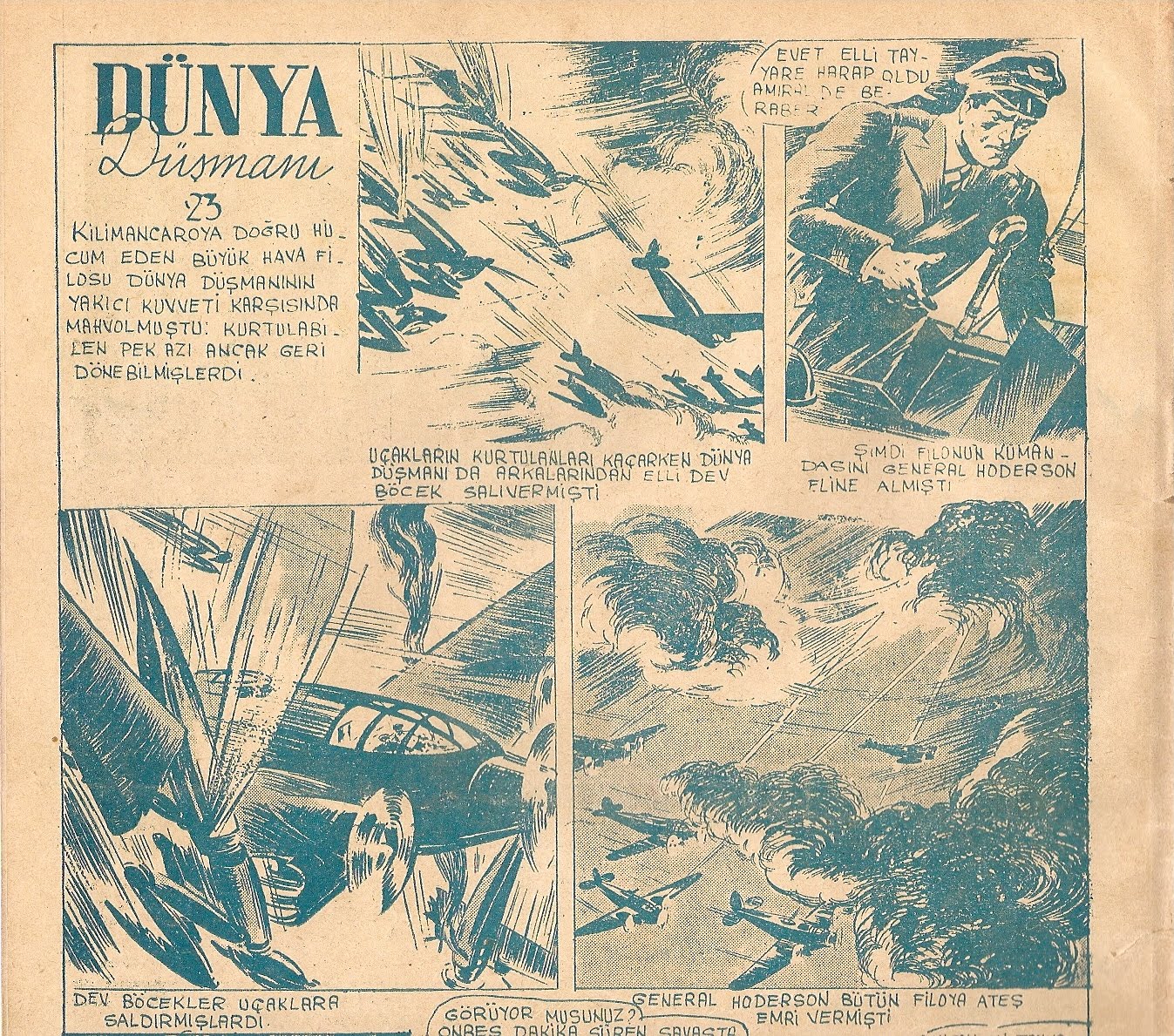
An obscure children's adventure comics with fantasy elements was serialized in the Turkish children's magazine Çocuk Sesi between 1935-36. Titled as 'Yamanla Duman' [Yaman and Duman], it told of the adventures of two teenage kids, initially accompanied by their parrot (which seems to have disappeared in the later episodes).
The series began its run in no. 274, dated March 25th, 1935, with a typical orientalist (good whites versus bad Arabs) episode, admittedly with some mystery trappings. A train has simply vanished in the forests of Egypt and the two kids named Yaman and Duman boldly set out to solve the mystery. Below are scans of the first two pages:


Fantasy elements first begin to emerge with the appearance of two giant birds during the interim between the first and the second episodes:


Next, the kids come across a land of midgets whom they befriend:


After which they encounter a colony of ancient Egyptians:


The subsequent adventure kicks off with the kids being captured by what appears to be a giant octopus..

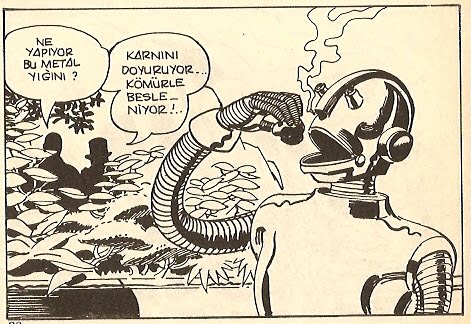
..which turns out to be a mechanical submarine in reality. The boys are taken to an enclave beneath the waters in which they encounter an evil robot!

Further adventures entail a return to the colony of ancient Egyptians where they are mummified to buried alive after the death of the phorah, encounter with giants, with cannibals et al... The run of the strips ends with no. 345, dated Aug. 3rd, 1936.
If anyone knows about the original source of this interesting comics, please let us know..

Friday, November 27, 2009

SWEDEN'S ADAMSON IN TURKEY


The Swedish gag-strip 'Adamson', featuring a cigar-smoking middle-aged man and created by Oscar Jacobson (1889-1945), was ran in the Turkish children's magazine Çocuk Sesi between 1934-36. The Turkish edition was initially titled as 'Bican Efendi', probably in an allusion to the Turkish short comedy film series from 1921 with the same name. However, the title was soon changed into 'Bican Aktüre' with the hero given a 'proper' a surname, in keeping with the government's modernization reforms which entailed introduction of surnames in Turkey!
As seen in the above scan (from no. 252, dated Oct. 22nd, 1934), the strip was accompanied with extensive extra-panel texts in the Turkish editions.
Adamson was reportedly syndicated in several other countries the throughout world.

Thursday, November 26, 2009

DEBUT OF MANDRAKE THE MAGICIAN COMICS IN TURKEY


Mandrake the Magician's Turkish debut came in 1935, less than a year after the strip's debut in the US. A weekly actuality magazine titled Büyük Gazete began to serialize Mandrake in its back covers beginning with its no. 30 on 13.5.1935. This makes Mandrake's Turkish debut the earliest known appearance of this hero outside newspapers anywhere in the world.
Below are scans of the beginning of Mandrake's first-ever adventure from its Turkish edition in Büyük Gazete, featuring the first-ever appearances of not only Mandrake and Lothar, but also of their arch-nemesis Cobra.


Note that the last two rows (dailies) feature the signature of artist Phil Davis; it has widely been reported that creator-writer Lee Falk was largely responsible for drawing the first few dailies before Davis took over drawing.

Monday, November 23, 2009

'BOBBY & CHIP' IN TURKISH CHILDREN'S MAGAZINE FROM 1939


I've just realized that the 'Bobby & Chip' gag-a-week comics from Britain's Mickey Mouse Weekly was also ran in the Turkish children's magazine Afacan in 1939. Re-titled as 'Hop ile Top', it debutted in the bottom third of the reverse side of the front cover of no. 221, dated Feb. 9th, 1939 (above scan). It turned into monochrome from no. 235 onwards and lasted till no. 249.
Afacan had also ran some British-made Disney comics from MMW as well.

Sunday, November 22, 2009

BOBBY & CHIP WITH MICKEY MOUSE


As noted in an earlier post in this blog on Oct. 31st, the gag comics 'Bobby & Chip' which had been running in Britain's Mickey Mouse Weekly since its inception was discontinued after no. 27, but resumed early in 1937. Its resumption was first heralded in no. 51's editorial page with the announcement that in the magazine's anniversary issue two weeks from then, "two old friends are coming on a visit to pages 6 and 7, laden with laughter." This news was made more explicit in the editorial of no. 52 with the 'two old friends' disclosed as Bobby and Chip, accompanied with the above illustration, whose artist is unknown. 'Bobby & Chip' would indeed resume in no. 53.

Sunday, November 15, 2009

'BOBBY & CHIP' IN THE US COMICS


I've recently realized that the 'Bobby & Chip' gag comics, featured in Britain's Mickey Mouse Weekly for several years since its inception in 1936, had also been published in some US comics, including Mickey Mouse Magazine. The above scan is from vol. 4 no. 1 (Oct. 1938) of MMM, reprinting a 'Boby & Chip' gag from no. 15 (May 16th, 1936) of MMW (note that the above American reprint edition is missing the second panel of the original UK edition):
In the same year, 'Bobby & Chip' was also reportedly published in the no. 1 of a US publication titled Nickel Comics from Dell Publishing. Online sources claim the famed Felix the Cat creater Otto Messner was the artist behind the 'Bobby & Chip' of Nickel Comics, a doubtful credit in my opinion.
It should also be added that the 'humourous 'Skit & Skat' comics from MMW were also ran in MMM in 1938.

Monday, November 2, 2009

BRITAIN'S FIRST SCIENCE-FICTION COMICS


Apart from gag comics, the non-Disneyic material in Britain's Mickey Mouse Magazine also included serious adventure comics. These consisted, on one had, of reprints of American Sunday newspaper comics in the color central pages, and, on the other, black&white comics by mostly British artists. Pioneer British newspaper comics artist Hugh Stanley White (1904-84) was responsible for most of the latter material in the early issues. The first issue of MMW, dated Feb. 8th, 1936, featured two comics by White: the full-page 'Ian on Mu' and the three-row 'Ginger Nick the Whaler'.
'Ian on Mu' is referred to as Britain's first science-fiction comics by online comics encyclopedia Lambiek. As can be seen in the above scan from its first installement at no.1, it tells the story of an expedition to a mysterious planet. Nevertheless, apart from the appearance of some robots, full-fledged sci-fi elements do not really bloom in its 15-issues run. The expedion discovers a Chinese (!) colony on this planet and sets out to rescue its imprisoned princess from rouge elements.
'Ginger Nick the Whaler', on the other hand, is more mundane and lasted for only 11 issues.

Black&white adventure comics by British artists continued to be serialized in MMW until 1939 when their pages were taken over by 'Lone Ranger':
title MMW issues year artist
The Road to Rome 16-25 1936 Reg Perrot
Gordon Gale - Air Rover 43-52 1936-37 Stephan Chapman
Green Eyes 53-60 1937 ?
The City of Jewels 61-72 1937 John McCail
The Lost Colony of Atlantis 73-87 1937 ?
Hawkeye 88-99 1937 ?
Wings of Fortune 100-109 1938 Reg Perrot
Phantom City 110-121 1938 Hugh S. White
Flashing Through 122-135 1938 Hugh S. White
Oil and Claw 136-147 1938 Hugh S. White
Conquest of the Gulf Stream 148-165 1938-39 ?

Saturday, October 31, 2009

NON-DISNEYIC GAG COMICS IN BRITAIN'S MICKEY MOUSE WEEKLY (1936)


Britain's Mickey Mouse Weekly is notable for many reasons. As frequently cited, it is Britain's first comics magazine to be published with photogravure printing which allowed high-quality color reproductions, a factor which undoubtedly contributed to its circulation of more than half a million. It featured, naturally, Disney comics and stories, some of them reprints of US newspaper comics and some of them original British products, but its contents also included non-Disneyic material as well. The non-Disney comics ran in MMW can be grouped into two categories: the humourous, gag-a-week comics and serious, adventure comics with narratives continuing into subsequent weeks. This post will cover the gag comics ran in the early issues of the magazine.
The first issue of MMW, which came out on Feb. 8th, 1936, featured four non-Disneyic gag comics. The most prominent of them was the full-page 'Adventures of Skit and Skat'. However, since it frequently experimented with continous narratives, it needs to be covered separately. The longest running of the strictly gag-a-week comics from the first issue would be 'Bobby & Chip' (see the image at the top of this post for its debut in no.1). It lasted for 27 issues only to be replaced by another gag comics, 'Heavenly Twins'. However, early in 1937, it would re-emerge in a new format as a single-row strip covering the bottom portions of the central color pages and would continue there for several years. Another gag-a-week comics of no.1 was 'Troubles of Father', but it would last for only the first 16 issues.

Rounding up the gag-a-week comics of the first issue of MMW was 'The Adventures of Bobby Bear'. This last comics was also being run in the British newspaper Daily Mail since 1919.

The second issue of MMW saw the debut of 'Percy Go-Bang' ...

... which would be replaced from no. 18 onwards with 'Little Lulu':

'Percy Go-Bang' would briefly be revived in some issues later in 1936, but would't survive into 1937. A similar fate befell 'Bob the Bugler' which had debutted in no.7:

'Sea Shanties', which had debutted on no.12, differed from the other gag comics of MMW with its elaborate, if not labourous, artwork:

From no. 19 onwards, it would be reformatted in a more creative layout:

From no.33 onwards, 'Sea Shanties' would be replaced by 'Circus Capers' which would contiue till no. 44.
The writers/artists behind these gag comics (other than 'Skit and Skat', which is known to be the work of Basil Reynolds) are unknown to me and any help in that regard would be welcome.
UPDATE: From http://bearalley.blogspot.com/, I've recently learned that the artist of 'Troubles of Father', 'Bob the Bugler', 'Sea Shanties' and 'Circus Capers' was Reg Carter; see post dated July 30, 2008 from that blog for info on Carter.

Sunday, October 25, 2009

THE LEGENDARY 1001 ROMAN

Türkiye Yayınevi's (Türkiye Publishing House) 1001 Roman weekly is a legendary title in the history of comics publications in Turkey. It was highly popular, very influential and is still fondly remembered by older generations. For instance, in a recent poll on living Turkish authors, many cited it among the top of their childhood favorites. And for the new generation of comics fans, it radiates a magnetism so powerful as to make them nostalgic for an era they have missed.
Türkiye Yayınevi's founder and owner Tahsin Demiray was actually a quite shadowy figure. Self-confessed to working for the secret intelligence service spying on Communists in Turkey in the early 1920s, he would be involved with extreme right-wing politics in his later life. He is said to have built his fortunes by receiving the monopoly of publishing alphabet material from the government in the late 1920s, quite a big business in Turkey in those years as the Arabic script was banned and the Latin script made obligatory as part of westernization reforms.
In 1936, Demiray's Türkiye Yayınevi (whose locomotive publication would be the popular cinema magazine Yıldız) began publishing two children's magazines, Yavrutürk and Ateş, both of which featured some comics among their pages alongside stories, etc. While Yavrutürk, which appealed to a more juvenile readership, ran 'Kara Kedi' (Felix the Cat) continuities as well as 'Vakvak Kardeş' (Donald Duck) gags, Ateş's 1st series (1936-37) serialized Mandrake's first-ever adventure as well as some obscure comics; its 2nd series (1937-38) only featured Mandrake as comics material. On the other hand, 1001 Roman which began on 10.7.1939, less than two months prior to the outbreak of the 2nd World War!, devoted the majority of its pages, even including its front page, to comics. The stable of comics featured in 1001 Roman over the years includes 'Brik Bradford', 'Alptekin' (Buck Rogers), 'Sevim Gazeteci' (Connie), Mandrake, 'Kartal İzciler' (Eagle Scout Roy Powers), 'Maskeli Süvari' (Lone Ranger), 'Gizli Polis X-9', 'Yıldırım Polis' (King of the Royal Mounted), 'İki İzci' (Tim Tyler's Luck), 'Kızılmaske' (Phantom) and Tarzan. Beginning with 1940, Türkiye Yayınevi also began to publish monthly 'special issues' of 1001 Roman, each issue of which was devoted to a single character.
Below: covers of 'special issues' no.1, 3 and 10, all from 1940
1001 Roman survived throughout the war years thanks to high sales, which was said to be in "tens of thousands", even though paper scarcity eventually necessitated a cutback in the number of pages. However, continuing economic hardships even after the war caused a cessation of 1001 Roman's publication in its original format after no. 350 in 1946, as well as the cancellation of the special issues after no.75 at the same time, with the promise of going back to more comics when possible. 1001 Roman's 2nd series included only neglible amount of comics. As promised, the 3rd series (1948-52) emerged in the original format. A novelty of the 3rd series was the introduction of romance comics, but another highlight was 'Nat Pinkerton' (Rip Kirby). The production techniques in 1001 Roman were various. It is not known if any of the comics were licensed or not; the magazine carried no copyright claims, so it can assumed that they were unlicensed. However, unlike the unlicensed comics of the 1950s and onwards, most were printed from originals, and not from traced copies even though some were, and increasingly more so over the years.The 3rd series ended in 1952 after no. 213. That year, Türkiye Yayınevi began to publish Haftalık Albüm (Weekly Album) similar to the format of 1001 Roman's monthly special issues from the war years. It lasted for about a year, after which Türkiye Yayınevi seems to have pulled back from comics publishing.

DEBUT OF FLASH GORDON IN TURKEY contd.


Above: The first panels, announcing impending disaster of a star approaching the Earth. Right: Introduction of Baytekin & Miss Yıldız (Later they embark on a mission to an alien planet which is the source of the threat against the Earth). Below: First vision of the planet.


Below: First perils on the planet


Above: They are taken to the ruler of the planet. Below: The emperor's daughter objects to his father's death ruling on Baytekin and both flee.


Above: The emperor's warcrafts go on a rampage. Below: Difficult times for Yıldız who had remained at the hands of the emperor.

DEBUT OF FLASH GORDON IN TURKEY

While it has been reported that 'Bringing Up Father' was published in a Turkish magazine before the 1930s, it can safely be said that the potential of the comics medium was first realized by Mehmet Gürtunca in 1935. Two children's magazines published by Gürtunca, Çocuk Sesi and Afacan, were giving place to comics among its pages alonside stories, etc. Afacan's 1st series, which started in 1932, capitalized on Mickey Mouse strip continuities. Both Afacan and Çocuk Sesi, which had started in 1930, also published humorous juvenile comics continuities by Orhan Tolon, regarded as the first Turkish comics artist. Afacan's 2nd series, which started in 1934, began running 'Avcı Baytekin' (Jungle Jim) and Tarzan. Then, 'Baytekin' (Flash Gordon) began in color in the center pages of Çocuk Sesi with no. 281 (13.5.1935) and caused a big sensation.
Above: cover of Çocuk Sesi no. 381, announcing the start of the amazing adventures of Baytekin. Below: two further covers of Çocuk Sesi from 1935.

On July 6th, Gürtunca's Ülkü Yayınevi (Ülkü Publishing House) published an Avcı Baytekin album, which is apparently the first comics book ever published in Turkey. It was followed in August with six Secret Agent X-9 albums, confusingly titled Baytekin (it should be noted that the Turkish publishers presented all three characters by Alex Raymond as if they were the same character, venturing into the jungles, into the space and working as a secret police from time to time!). In September, seven Mickey Mouse albums and at least three more Baytekin (X-9) albums were published. It was claimed that some of these albums, for instance the Baytekin / X-9 ones, reached a circulation of 50,000.

THE MYSTERIOUS FLAME OF QUEEN LOANA IS BACK

Well, I've had a turbulent and recently very rough period of my life this year; and couldn't get back on any of my blogs. Now, I am trying to pull together again.
I did have an extensive web site on comics publishers of Turkey over at geocities which is closing down. So, I will take that as an opportunity to re-flame this blog by moving pre-war related material over there to here.

Tuesday, December 23, 2008

YUGOSLAVIAN COMICS IN TURKEY - PART 1: COUNTESS MARGO


Several pre-war comics of Yugoslavian origin were among the many comics published in Turkey's major war-time weekly comics magazine 1001 Roman during the last two years of its first series (1939-46). Especially the works of artist Konstantin Kuznjecov appear to have been featured regularly between 1945-46. The first comics by Kuznjecov that I have been able to identify as being reprinted in 1001 Roman is the outstanding 'Grofica Margo (Countess Margo)' which was serialized in no.'s 283-327 in 1945 as 'Kontes Margo'. It had originally been published in Yugoslavia's Mika Miš comics magazine in 1938.
'Grofica Margo' is remarkable for both its story and for its graphic qualities. The non-conventional page layout with playing cards imaginatively scattered amongst the panels in the above scan is a good example of the latter quality. As for the story, it is built on a terrific mystery plot with some delicious gothic trappings, both in terms of themes and of motifs. The comics begins with an elderly count living alone in a castle dying of fright at the appearance of a ghosly female figure at midnight. His heirs come to the castle and learn the terrible curse haunting the family. The recounting of origin of the curse entails a very long flashback, running 17 full pages in the Turkish edition. More than 300 hundred years ago, an ancester of the family had married a peasant girl named Margo. Unfortunately, she couldn't bear him a male child and, worried that she might lose her husband because of this reason, the misguided young woman, assisted by her grandmother, kill her female newborn with the intention of replacing the poor infant with a male baby! I guess the theme of maternal infanticide is very rare in comics. This shocking murder is depicted as such in the below panel:

The gruesomely cruel actions do not end here as the husband, who happens to fall onto the scene just too late, has poor Margo walled up in a chamber alive... Her grandmother curses the whole family as a result.
After the long flashback ends, the plot resumes with further appearances of a ghost in the castle terrorizing the new owners as well as some less supernatural-looking attempts on their lives. With secret passages and black hooded figures, it reminds me the best of Edgar Wallace mysteries, esp. The Black Abbot (1926).


The Turkish edition in 1001 Roman is a flawed reprint unfortunately. Some sequences during the flashback appear to be abridged with a few pages completely redrawn ineptly for some reason. Furthermore, roughly halfway through the story, the format changes from full page (as in the first scan at the top of this blog) to 2/3rds of a page with standartly neat row/panel design (as in the above scan) at the expense of the free-style layout of the earlier pages.
Prior to its run at 1001 Roman, 'Grofica Margo' had also been reprinted in the French comics magazine Gavroche (no. 13-54) in 1941 in a colorized edition which foregoes the subtleties of the original black&white art.
'Kontes Margo' was followed in 1001 Roman by yet another Kuznjecov comics, but that will be covered in the next post in this blog, so stay tuned on...

Saturday, December 13, 2008

MACISTE IN VINTAGE COMICS ADAPTATION OF CABIRIA (UPDATED WITH NEW INFO)


Maciste is the most prominent hero of Italian popular cinema and also probably the oldest recurring character in world cinema. He was featured in a long-running series of Italian films from mid-1910s to late 1920s in the era of silent cinema and was revived in Italy in the 1960s with more than a dozen further Maciste films in the first half of the decade (Since most of the 1960s movies were re-named as Hercules movies when released in the US, he is not as well known in the English-speaking lands).
Maciste had actually made his first appearance as a side character (and a black-skinned one) in the seminal Italian silent film Cabiria (1914) before rising to hero status in the follow-up series. Cabiria tells the story of the misfortunes of a Roman maiden, the title heroine, abducted to Cartagha. Maciste is the side-kick of the hero who rescues her from ritual sacrifice.
A comics adaptation of Cabiria, co-illustrated by Raffaele Paparella and Antonio Canale, was serialized in the Italian weekly comics magazine Topolino no.'s 527-554 in 1943 which was later reprinted in Turkish comics weekly 1001 Roman in 1945-46 (no.'s 306-337) under the title 'Kabria'. The above panel (all scans in this post are from the Turkish edition) is the first appearance of Maciste (spelled as 'Masist') in this comics adaptation. The plot synopsises of Cabiria refer to Maciste as the lead protagonist's slave, but the Turkish text refers to him as his servant. Below is another panel with Maciste, breaking his chains a la Hercules:


The comics appear to be a pretty faithful adaptation of the movie, as witnessed in the below panel and its corresponding still from the movie:


Below is another impressive panel, depicting the march of Hannibal's war elephants, reprising another scene reportedly in the film ('though I couldn't find any stills of it on the net):

UPDATE: Armando Botto from Italy kindly informs that the Turkish edition in 1001 Roman has been re-colored as the original Italian edition in Topolino was in black and magenta; he also adds that some panels in 1001 Roman have been re-formatted together with some other changes such as "while your "temple" panel is just a part of the original one, the"elephants" one has had some details added (part of the mountains in the background,and also a few elephants)." Thank you once again, Armando..

Thursday, March 20, 2008

PROFESSEUR NIMBUS


'Professeur Nimbus' was a wordless pre-war French comics strip created by former animator André Daix [Delachenal] in 1934. While the initial gags reportedly featured Nimbus as an inventor, his scientist career was eventually phased out even though the professor credential lingered on in the strip's title. Daix became a Nazi-collaborator during the 2nd World War and had to flee his country after the war for exile in Latin America.
Nimbus made his Turkish debut in the children's weekly magazine Yavrutürk which had started publication in 1936. He was renamed as 'Tektel Amca' (Single-hair Uncle). At least in one occasion, he was featured on the cover, which was a quite unusual practice in Yavrutürk as the magazine almost never featured any comics character on its covers. Below are a sample of Nimbus strips published in several issues of Yavrutürk in 1937:

Wednesday, March 19, 2008

FELIX THE CAT IN TURKEY

'Felix the Cat' comics, featuring the legendary silent-era animation character of the same name, first appeared in Turkey as 'Karakedi' [Blackcat] in the weekly children's magazine Yavrutürk which had began publication in 1936. Below is the back cover of the no.63, dated 10.7.1937, of v.3 of Yavrutürk featuring Felix in the Stone Age (if you click on the image, a larger-sized version will appear). If anyone can identify or estimate the original US publication date of this material, please let us know.

Tuesday, February 12, 2008

JUNGLE JIM (pt. 2)

JJ05 (7.10-1934-7.7.1935): With this adventure, whose duration is more than that of all previous episodes combined, the creativity in 'Jungle Jim' blossoms with regards to both the art and the content. After the death of her villainous father, Joan seems to have settled with Jim for the time being, and Zobi the jungle-boy has parted them; hence, a scantily-clad adolescent boy has departed and left the scene for a young woman. The adventure truly kicks off with the arrival of a seasoned adventurer named Malay Mike who claims that the extinct species of saber-tooth tigers live in a valley where no man other than himself has set foot in. Sceptic and yet intrigued, Jim nevertheless set out an expedition on this tip. Grisly sights such as the below mise-an-scene encountered at the onset of the expedition signal that this adventure will be no routine stuff.
Jim and his companions discover more than saber-toothed tigers in the valley where an extinct volcano has been hollowed out and turned into a fortress and a religious temple, the headquarters of a Chinese despot bent on exploiting the gold mines in the region. While the presence of a Chinese villain is superficially reminiscent of the 'Yellow Peril' narratives in the vein of Fu Manchu, the fact that a Chinese secret agent as well as local (Malayan) natives join forces with Jim and friends rule out this adventure from such racist territories.
The story is also enriched by several 'guilty-pleasure' motifs such as girl in bondage, girl-girl fight and gun-toting girl (all featuring Joan):
In terms of graphic design, Raymond experiments with several styles in the course of this long adventure which starts as a 'three-tier' (three rows of panels) as were all the previous adventures. On the Dec. 12nd page, he begins to introduce larger panels among regular-size ones, thus breaking up the neat panel-row structure. For several weeks, he alternates between this irregular format and a two-tier format, abondoning the three-tier format completely. From February onwards, the page even leaves out the oblong-size format altogether and becomes taller than wider. Towards the end of the adventure, it reverts back to the oblong-format, settling with a two-tier structure. Meanwhile, the routine "to be continued" tagline at the end of each page has also disappered, eventually giving way to the announcement of the subject of the coming weekly page.

[JJ06] River Pirates (14.7.1935-27.10.1935): A simple adventure where Jim rescue a widow and her infant from a disgruntled ex-lover, the high point of which is Jim and Kolu being left buried in the sand for ants to devour them, not to mention lovingly rendered damsel-in-distress illustrations. Surprisingly, Joan departs with the widow to head back to the US, leaving a note disclosing that she loved Jim but did not want to impose herself on him (a situation which will be repeated in several early 'Phantom' adventures). Reading the note, Jim says to himself "what a blind fool I am", perhaps referring to the two nights ago where they had slept outdoors all along by themselves on opposite sides of the fire.
In the coming adventures, Jungle Jim will meet an imposing female, but that's another story, to be reconted in future postings in this blog.
AN INAPPROPRIATELY SPECULATIVE APPENDIX WITH NO COMMENT:

Friday, February 1, 2008

JUNGLE JIM (pt 1)

'Jungle Jim' is an underrated comics which has been overshadowed by legendary US comics artist Alex Raymond's other works, 'Flash Gordon' being the most famous one. However, not ony its artwork is bestowed with the quality of other Raymonds works from the pre-war era, but its characterizations and narratives are also noteable for many reasons.
Simultanously as 'Flash Gordon was commissoned by the King Features to compete with 'Buck Rogers', 'Jungle Jim' was commissoned as a competitor to 'Tarzan' and both debutted on Jan. 7th, 1934 as complementary Sunday features (see the below image for the first appearance of the hero on its first page). Though only the Raymond byline appeared on the comics, it was scripted by Don Moore and most reference sources identify him as the creator. Moore (1904-86) was a former newsman who was editing adventure stories for a NY magazine when he was recruited into the comics field by the King Features. Later he would move onto television as script-writer.

At least at its inception, Jungle Jim was clearly modeled directly on real-life adventurer Frank Buck who was very famous in those years on the basis of his best-selling memoir book Bring 'Em Back Alive and its movie adaptation with the same title, which he himself starred. In the first story, Jim Bradley alias Jungle Jim was presented as a trapper and tamer capturing wild-life specimens for zoos, precisely as a fictional replica of Frank Buck. Moreover, he was based in the Malay peninsula, which happened to be the setting of Buck's first movie.
Jim was accompanied by a native "servant" named Kolu, making 'Jungle Jim' probably the first American adventure comics to feature an inter-racial duo as protagonists, predating Mandrake and Lothar by several months. Moreover, whereas the pre-war Lothar was portrayed frequently as an 'all muscle, no brains' figure strictly for ridicule, Kolu was a genuinely indispendable right-hand man for Jim with no inferiority attributed to him, other than being an employee. Actually, at least in the first one and a half years of the comics' run which I have read so far, Kolu, thanks to his marksmenship talent, turned out to be Jim's saviour at the last moment in more occasions than Jim saved him or other people! Furthermore, in one occasion (Aug 8th, 1934), he speaks on behalf of himself and Jim, in the presence of Jim and a third party without Jim expressing his opinion first.
Bits of scarce info on the web name Jim's steady as Lil De Vrille, but a blonde named Joan appears as the candidate for this role in the first stories. Despite the fact that she is introduced into the comics by way of being rescued by Jim and Kolu from jungle perils (see the above image), she doesn't turn out to be the standard feminine stereotype, asking for instance Jim to teach her to tame wild animals (which he complies) and joining the men in dangerous missions as any other character (withoout any objection from Jim). To revert to comparison with the Mandrake strip, she is the direct opposite to Narda, and on even more equal footing with the male protagonists than Phantom's Diana.

The graphic and narrative qualities of the comics evolve progressively during the comics' first one and a half years' run. None of the adventures have episode titles, so I will be assigning them codes for convenience.
JJ01 (7.1.1934-3.3.1934): Almost every single page has Jim fighting a wild animal leaping at him in the forest during the course of a simple story about a villain named Tiger Peters (Joan is his daughter) stealing the animals Jim had captured. The adventure ends with Peters managing to escape, taking his daughter with him.
JJ02 (3.3.1934-3.6.1934): This adventure has got a more interesting and relatively more complex story, but the plot is poorly developed. A black lion is terrorizing a nearby tribe and Jim sets out to capture this never before seen specimen. On the other hand, a white guy seeks refuge from natives who want to sacrifice him to a god. It turns out that an evil white man has imposed himself as god onto a tribe and using this power to extort money from foreigners. However, how and where the black lion angle fits into this schema is not satisfactorily explained, esp. with regards to the double revelation that, on one hand, some of the attacks attributed to the black lion were the work of natives in costume and on the other hand the black lion was real enough itself. It seems Moore was undecided on what course the story should develop and eventually could not manage to pull all the conflicting ends let loose. As for the racial representations involved in this story, Jim's earlier reference to the native tribe dominated by the white villain posing as a god as "ignorant blacks" appears as a fly in a glass of milk and yet in the end, when he urges these folks to return to their "old faith that taught you kindness and brotherly love", the comics stand in contrast to the racist rhetorics of colonialist stories.
JJ03 (3.6.1934-1.7.1934): This mini-episode perhaps should better be viewed as a prologue of the next adventure. A panther captured by Jim turns out to be the pet of a jungle boy named Zobi, who'll accompany him and Kolu in the coming adventure. It seems writer Moore was tentatively considering introducing Zobi as a permament side-kick in this period.
JJ04 (1.7.1934-30.9.1934): An old friend of Jim visits him to request help in defeating a gang robbing gold miners. The leader of the gang turns out to be Tiger Peter from the very first adventure and hence Jim and Joan reunite. Except for one single instance of a lion attack, this is a standart action adventure, climaxed by gun fights, without any jungle perils and could have been set in any location and not necessarily in the jungle region.
From Aug. 19th onwards, one third of the 'Jungle Jim' Sunday comics half-page is devoted to cut-outs, usually featuring scantily-clad female characters from 'Flash Gordon', but, in two occasions, Joan from 'Jungle Jim' itself, the first of which is below:
Around the same time, the art of the comics itself began to show some signs of flair, such as in the below panel:

With the next adventure, the creativity in 'Jungle Jim' will blossom with regards to both the art and the content, but that will be discussed in the next installement in this blog.. TO BE CONTINUED