Showing posts with label 1001 roman. Show all posts

Monday, September 12, 2011

EARLY WAR-TIME FRENCH WAR COMICS


Above scan is of a panel from the 8th installement of 'Vatan İçin [For the Homeland]' from the back cover o no. 36 (dated Mar. 11th, 1940) of Turkey's 1001 Roman weekly comics magazine. 'Vatan İçin', serialized between no.'s 29-54 of 1001 Roman, is the Turkish edition of 'Jean-Jacques Ardent à la Guerre ['Jean-Jacques Ardent at the War]' serialized in the French magazine Junior in 1939-40. Ardent was originally an athlete character created by René Pellos in 1938; Pellos (1900-1998) is better known for his 'Futuropolis', the first non-juvenile French sci-fi comics saga. 'Vatan İçin' was the only comics series published in 1001 Roman credited to its original source, with the tag "Fransızca Junior gazetesinden alınmıştır [taken from the French Junior gazette]" in its title caption. This was probably due to an intent to show sympathy for France in the newly erupted 2nd World War (Turkey had officially signed an alliance with Britain and France soon after the war had erupted, even though this alliance would in effect remain only on paper). Ironically, the German invasion of France would be initiated a few months after 'Vatan İçin' began to serialized in 1001 Roman and France would surrender before the serialization ended. The Turkish edition ends with Ardent being shot and falling down from a bridge which he had planted explosives, and sinking down into the waters below, with his last words as "Oh.! I am happy!.. I am dying for the sake of the independence of my homeland":
UPDATE: I've updated my below posts on Sept. 5th, Sept. 9th and Sept. 10th with the identifications of the original sources of the covered comics. However, comics covered in the posts on Sept. 8th and Sept. 11th still remain unidentified.

Sunday, September 11, 2011

ATTACK OF THE GIANT INSECTS


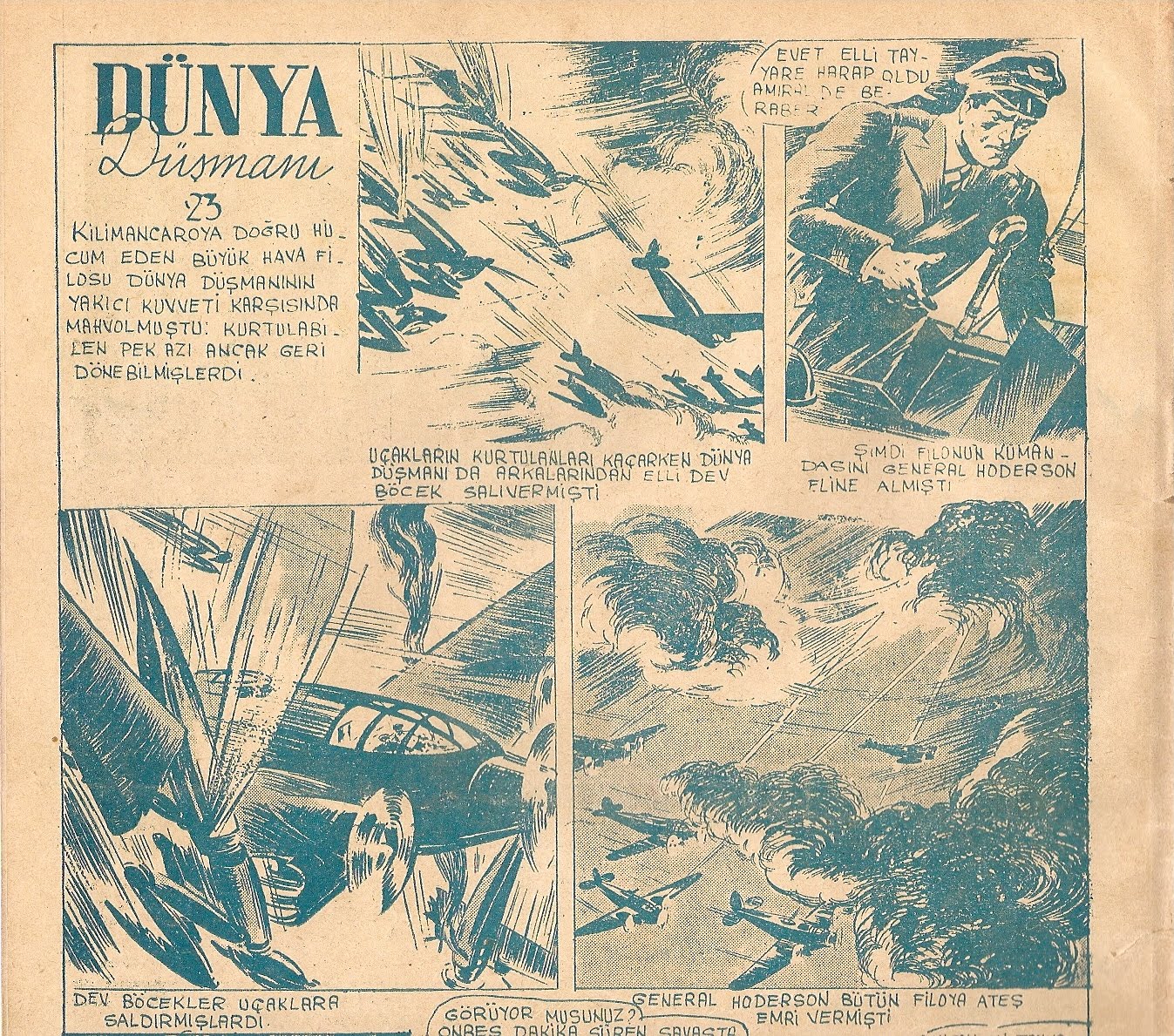
Above scan of a panel from 'Dünya Düşmanı [Enemy of the World]', an obscure science fiction comics of French origin serialized in the back covers of the first 28 issues of Turkey's 1001 Roman is from the no. 3 (dated July 24th, 1939) of this weekly comics magazine. The original title of 'Dünya Düşmanı' was 'L'Ennemi du monde' and it had originally commenced in  L'Epatant, the leading French comics magazine of the pre-war era, but continued in L'As when the former magazine folded in 1939; the artist was Pierre Duteurtre (1911-1989).
The plot of 'Dünya Düşmanı' kicks off with an attack of giant insects on colonial Africa accompanied with a wireless ultimatum coming from a mysterious voice calling for total submission of world nations. Lieutenant Nelson volunteers on a rescue mission to a camp on the outskirts of Mount Kilimanjaro which has been raided by the giant insects. The camp is also being threatened by over-size lions, as seen in the below scan from no. 4:

Upon arriving at the camp, Nelson and his compatriots detain a suspicious young woman who is soon set free by over-size natives which then empower Nelson and co. (scan from no. 17):
Nelson and co. are taken to the hideout of the main villain (scan from no. 20):
They learn that the culprit is a scientist named Bravona who has developed a serum which he calls "serum B.K." that causes abnormal growth in the size of living beings. Meanwhile, airforce attacks the hideout of the mad scientist, but meets devastating defence by the giant insects (scan from no. 23):

The comics ends with Nelson shutting down an electric shield, allowing for missiles to hit the hideout.
I think this is a very interesting comics because it is probably the earliest manifestation of giant insects in the comics medium, predating the giant insect boom of the 1950s by more than a decade. The idea of a scientifically developed chemical substance causing abormal size growth of living beings might have been inspired by H.G. Wells' novel Food of the Gods (1905), but utilizing that idea within the context of a mad scientist bent on conquering the world is pretty original for the pre-war era as far as I am aware.
Artist Duteurtre's post-war credits include the second volume of the sci-fi saga 'Guerre a la Terre' and the long running series 'Sitting Bull', both from Coq Hardi.

Saturday, September 10, 2011

SHARK SCENE IN PRE-WAR COMICS


Above scan is from the no.1 (dated July 10th, 1939) of Turkey's 1001 Roman, featuring a shark scene from the first installement of 'Korkusuz Adam [The Fearless Man]', serialized in the first 22 issues of this weekly comics magazine. 'Korkusuz Adam' is the Turkish edition of 'Metropoli Distrutta' by the Italian artist Ferdinando Vichi (1901-1944), originally serialized in the Italian comics weekly L'Avventuroso in 1938. The original Italian version is said to be anti-communisy and fascistic (*), but these sentiments are not as evident in the Turkish edition. During the course of the Turkish translation, the protagonist has been given a Turkish name and nationality. He is an "engineer" (=inventor?) who has made a valuable invention and hence is being sought after by a band of "international spies", seen in the below scan from no. 3:
In order to evade capture by the spies, the hero seeks shelter in an exotic island inhabited by "savages". Towards the finale, an elderly white man who commands apes appears, as seen in this scan from no. 18:

(*) Claudio Carabba, Il fasciso a fumetti, p. 273.

Friday, September 9, 2011

FANTASTIC GIANT OCTOPUS ATTACK SCENE IN PRE-WAR COLONIALIST COMICS


Above scans are from the no. 19 (dated Nov. 13th, 1939) of Turkey's 1001 Roman, featuring an installement of 'Gizli Ülke [Secret Country]' serialized in the first 22 issues of this comics weekly magazine on a two half pages per issue basis. This marvelous episode turns out to be part of a series of nightmarish hallucinations induced on a pair of adventurous American millionaires who were kidnapped and drugged by independence-seeking rebels of India.
'Gizli Ülke' is the Turkish edition of 'La Regina d'Atalanta', originally serialized in the Italian weekly comics magazine L'Avventuroso in 1936. While the art by Giove Toppi is highly imaginative, the underbelly of the script by Paolo Lorenzini, the director of L'Avventuroso, is shamelessly colonialist; for instance, the Indian rebels are aided by a Chinese villain!.. Below panel depicts the resistance of the rebels against the colonial troops who raid the temple where the Americans are being kept, the ringleader exclaiming "We shall not be captives."

You can view some sample pages from the original color edition of 'La Regina d'Atalanta' here (scroll down a little bit to reach 'La Regina d'Atalanta' scans): http://annitrenta.blogspot.com/2011/02/lavventuroso-11-1936-quarta-parte.html

Thursday, September 8, 2011

ANOTHER OCTOPUS ATTACK SCENE


Above scan is from the no. 100 (dated June 2nd, 1941) of Turkey's comics weekly 1001 Roman, featuring the 13th installement of an obscure comics titled 'Denizlerin Dibinde [At the Depths of the Seas]' serialized between no.'s 88-119. The plot is about the search in a sunken ship for some lost documents involving a military invention. I believe it is an early war-time Italian product as the protagonists are Italian (the hero is named "Kolombo") and the antagonists are French (the illain is named "Jan"). Below is a scan of the signature of the artist that I spotted in one of the panels:

As always, any help in identifying the artist's name, the original title and source would be much welcome.

Monday, September 5, 2011

GIANT OCTOPUS ATTACK SCENE IN PRE-WAR COMICS

Above scans are from the 13th and 14th installements of 'Denizaltı Tüneli [Undersea Tunnel]', an pre-war comics serialized in the Turkish comics weekly 1001 Roman, beginning with no. 23 (dated Dec. 11th, 1939) and lasting for 27 issues. 'Denizaltı Tüneli' is the Turkish edition of 'Il tunnel sottomariono', adapted from Luigi Motta's 1912 novel with the same title by comics artist Ferdinando Vichi and originally serialized in the Italian comics weekly Giungla in 1938 and published as an album in 1939. The plot concerns the building of an undersea tunnel across the atlantic from America to Ireland. Admittedly, it is a rather dull comics with the only exciting episode being this encounter with the giant octopus.

Tuesday, August 9, 2011

MANDRAKE IN 1001 ROMAN SPECIAL ISSUES (1940-46)


Between 1940-46, Türkiye Yayınevi published monthly "special issues" of 1001 Roman alongside the weekly comics magazine of the same title. Unlike the tabloid-format weekly magazine, these issues were smaller in size and each issue headlined a complete adventure of one comics character. Mandrake was featured in eight of these monthly issues, beginning with no. 1 (Jan. 1940). The Mandrake adventure in no. 1 is called 'Hindistanda [In India]' and was originally serialized in American Sunday newspapers in 1935 (it was the 2nd Mandrake adventure ran in the Sunday comics format), but the Turkish edition is slightly abridged.
The first three issues of the "special issue" series included a shorter, second comics story of a different character alonside the main featured character and Mandrake was featured in this way in no. 2 (Feb. 1940), which was a Lone Ranger issue, as well. Titled as 'Haydutlar kralına karşı [Against the King of the Bandits]', this filler comics is the first-ever Mandrake adventure originally ran in the Sunday newspapers, but the mere five-pages long Turkish edition reprints its conclusion only (thanks to Marko Davidovic for leading me to this blog post for comparison).
Below is a list of the remaining Mandrake issues from the 1001 Roman special issues:
#10 (Oct. 1940): 'Tekinsiz Evin Esrarı [The Mystery of the Uncanny House]', originally daily strip continuity #13 (1938); slightly abridged
#16 (Apr. 1941): 'Merihli İnsanlar [Martian People]', originally daily strip continuity #16 (1938); slightly abridged

#23 (Nov. 1941 [on-print date: Nov. "1940", a typo): 'Zehirli Kılıç [The Poisened Sword]', originally daily strip continuity #14 (1938); slightly abridged
#29 (May. 1942): 'Sudan Şahı [The Shah of Sudan]', originally daily strip continuity #7 (1936); starts half-way through the original adventure and the rest still slightly abridged
#69 (Sept. 1945): untitled, originally Sunday continuity #8 (1938); starts half-way through the original adventure

#75 (Mar. 1946*): untitled, originally Sunday continuity #13 (1940)
* last issue of the series

MANDRAKE IN 1001 ROMAN (1939-46)


In 1939, shortly before the outbreak of the 2nd World War, Tahsin Demiray's Türkiye Yayınevi, one of the leading pulishers of popular magazines in Turkey, launched the weekly 1001 Roman, Turkey's first comics magazine modeled on the European comics format (see this earlier post on a general coverage of this magazine). Mandrake the Magician soon joined the roster of comic strips serialized in this hugely popular magazine, beginning with no. 18 (dated Nov. 6th, 1939), as 'Mandrake - Sihirbazlar Kralı [Mandrake - The King of the Magicians]', a byline which would stuck with the character so much in Turkey that when, decades later, a weekly Mandrake comics would be launched in 1974, the logo on the first pages would once again utilize it.
The first two Mandrake adventures serialized in 1001 Roman were from American Sunday newspaper serials, reprinted in b&w here, but most of the subsequent adventures originated from daily strips. Between no.'s 87-108, Mandrake was published in the back covers and hence in color. With no. 197, after the end of the adventure where Mandrake faces his arch-nemesis Cobra for the second time (in terms of the strip's original run in US newspapers), 1001 Roman started re-running earlier adventures previously serialized in Ateş, beginning with Mandrake's first-ever adventure where he meets Cobra for the first time. So, the readers of 1001 Roman were presented with Mandrake's first encounter with Cobra after they were presented with the second encounter... It should also be noted that 1001 Roman, in the same manner as Ateş had done six years ago, presented Mandrake's first-ever adventure in an abridged form, omitting several panels, but the panels omitted in 1001 Roman were not same as those in Ateş, so 1001 Roman had not simply reprinted Ateş's edition; in anycase, the Turkish translation and the lettering were also different:
1001 Roman halted serializing Mandrake in 1945 after re-running three of the four adventures previously serialized in Ateş. After about a year of hiatus, one more Mandrake adventure was serialized in 1946, ending with the cessation of the publication of the weekly with no. 350. The final Mandrake adventure serialized in 1001 Roman was a daily strip continuity, originally run in US newspapers in 1938, where Mandrake visits Hollywood, but the Turkish editors began to serialize this continuity half-way through its first sub-plot and ended half-way through its second sub-plot at a convenient point when Mandrake teaches a spoiled child star some manners, before the kid gets kidnapped which was actually the main plot point of the narrative.
Here is a complete list of Mandrake adventures serialized in this Turkish comics weekly with the no.'s in 1001 Roman (and the years these issues were published), Turkish title [and translation], the conventional code referring to the sequence of American Sunday/daily strips (and the years they were originally ran in the US newspapers):
#18-36 (1939-40) Cüceler Ülkesinde [In the Land of the Midgets] s3 (1935-36)
#37-54 (1940) Gelecekte Bir Seyahat [A Voyage in the Future] s5 (1936-37)
#55-75 (1940) untitled d21 (1940)
#76-95 (1940-41) Sirkte Yangın [Fire at the Circus] s4 (1936)
#96-110 (1941) "Atmaca" Yarış Atı ["Hawk" the Race Horse] d10/2nd subplot (1937-38)
#111-132 (1941-1942) untitled d15 (1938)
#133-166 (1942) Meçhul Dünyalarda [In Unknown Worlds] d8 (1936-37)
#167-196 (1942-43) Kobra'ya Karşı [Against the Cobra] d9 (1937)
#197-246 (1943-44) Esrarengiz Adam [The Mysterious Man] d1 (1934)
#247-274 (1944) Dar Geçit [The Narrow Pass] d3 (1935)
#275-296 (1944-45) Gizli Oyun Yeri [The Secret Game Place] d2 (1934-35)
#342-350 (1946) untitled d11/only from 3-22 to 4-20 (1938)
Between 1940-46, Türkiye Yayınevi also published monthly 1001 Roman "special issues", and Mandrake were featured in several of them, but that will be covered in the next post in this blog.

Thursday, October 7, 2010

TARZAN COMICS IN TURKEY IN THE WARTIME ERA (AND BEYOND)


The serialization of Tarzan comics in b&w in Ülkü's children's weekly magazine Afacan, where comics of E.R.Burrough's jungle hero had made their Turkish debut in 1935, had ceased in 1939. Meanwhile, rival publisher Tahsin Demiray's Türkiye Yayınevi had began to publish the weekly 1001 Roman which allocated the majority of its pages to comics. With no. 78 (dated Dec. 30th, 1940), 'Tarzan' began to be serialized in color on the covers of this magazine, marking the color debut of Tarzan comics in Turkey. 1001 Roman started its run of Tarzan with an adventure where Tarzan encounters a Chinese colony which had been serialized as a Sunday newspaper continuity by Burne Hogarth in 1938-39 in the US. In addition, one issue of the monthly 'special issue' series of 1001 Roman also featured a Tarzan comics credited to the Turkish artist Ekrem Dülek (covered in the below post in this blog from Sept. 26). 'Tarzan' continued to be serialized on the covers of the weekly edition of 1001Roman without any breaks until the magazine folded in 1946.
Post-script - Brief overview of Tarzan comics in Turkey after the war:
In the post-war era, poorly traced Tarzan comics appeared in several Turkish magazines, an early example being 'Tarzan' serialized in Çocuk Alemi in 1948. The proper reprints of US Tarzan Sunday newspaper comics were ran in the supplement of Vatan newspaper in 1951.
The first Turkish comics magazine headlining Burrough's jungle hero would be the short-lived Tarzan published by Nihat Özcan in 1951. However, the longer-running Tarzan comics magazine from the late 1960s as well as its follow-up Süper Tarzan from the 1970s and 1980s would actually feature the Italian Tarzan-clone comics Akim! In similar vein, the 'Tarzan' photo-strip serialized in Yeni 1001 Roman in the late 1960s is actually Italian Tarzan clone photo-strip Antar. Meanwhile, the 'real' Tarzan comics would be serialized in children's magazines Doğan Kardeş with occasional breaks between 1967-77 and in Milliyet Çocuk in the 1980s.
It should also be noted that two parody-comics of Tarzan would be made in Turkey as well: 'Tarzan Eski Dünyalarda' [Tarzan In Ancient Worlds] scripted by Bülent Oran and illustrated by Suat Yalaz, serialized in satire/humour magazine Dolmuş in 1957 and the hugely popular 'Tarzan', later retitled as 'Tarzan ve Arap Kadri' [Tarzan and Kadri the Arab], serialized in Fırt from 1976 onwards.

Sunday, September 26, 2010

TARZAN AND NUMA: TURKISH-MADE TARZAN COMICS FROM 1943


In the below post on this blog, I had covered Turkish artist Ekrem Dülek's 'Boğaç Han' comics serialized in Çocuk Haftası in 1943-44. Dülek is also credited as the artist for an odd Tarzan comics published in the no. 43 (dated Sept. 3rd, 1943) of the monthly "special issue" series of 1001 Roman from the same publisher, Tahsin Demiray. Titled as 'Tarzan ve Numa' [Tarzan and Numa], this is the only instance I am aware of where a comics credited to a Turkish artist had been published in 1001 Roman.
'Tarzan ve Numa' appears to be partially based on the 'Lion' story in E.R. Burrough's Jungle Tales of Tarzan (1919). The first 8 pages of the comics where Tarzan sets out to save a gorilla snatched by Numa the lion is a fairly faithful adaptation of the introductory section of this story.


Afterwards, the plot of the comics digresses from that of the original story. Tarzan sees natives carrying the carcass of a lion, but finds out that it is not Numa:
Just when Numa appears on the scene, the natives come back to assault Tarzan and his apes..
.. but Numa joins in the fight against the natives and hence Tarzan befriends the lion in the end:
I suspect Dülek might have created this comics by tracing from and/or redrawing one or more foreign source. If anyone recognizes any one or set of images from elsewhere, please let us know. For example, a possible source might be the French Tarzan et le lion (1937) album from Hachette, which I haven't (yet) seen.
Source for Jungle Tales of Tarzan plot summary: http://www.erblist.com/erblist/jtalessummary.html
Coming soon in this blog: Turkish-made Son of Tarzan comics serial from 1945!!..

Sunday, October 25, 2009

THE LEGENDARY 1001 ROMAN


Türkiye Yayınevi's (Türkiye Publishing House) 1001 Roman weekly is a legendary title in the history of comics publications in Turkey. It was highly popular, very influential and is still fondly remembered by older generations. For instance, in a recent poll on living Turkish authors, many cited it among the top of their childhood favorites. And for the new generation of comics fans, it radiates a magnetism so powerful as to make them nostalgic for an era they have missed.
Türkiye Yayınevi's founder and owner Tahsin Demiray was actually a quite shadowy figure. Self-confessed to working for the secret intelligence service spying on Communists in Turkey in the early 1920s, he would be involved with right-wing politics in his later life (*). He is said to have built his fortunes by receiving the monopoly of publishing alphabet material from the government in the late 1920s, quite a big business in Turkey in those years as the Arabic script was banned and the Latin script made obligatory as part of westernization reforms.
In 1936, Demiray's Türkiye Yayınevi (whose locomotive publication would be the popular cinema magazine Yıldız) began publishing two children's magazines, Yavrutürk and Ateş, both of which featured some comics among their pages alongside stories, etc. While Yavrutürk, which appealed to a more juvenile readership, ran 'Kara Kedi' (Felix the Cat) continuities as well as 'Vakvak Kardeş' (Donald Duck) gags, Ateş's 1st series (1936-37) serialized Mandrake's first-ever adventure as well as some obscure comics; its 2nd series (1937-38) only featured Mandrake as comics material. On the other hand, 1001 Roman which began on 10.7.1939, less than two months prior to the outbreak of the 2nd World War!, devoted the majority of its pages, even including its front page, to comics. The stable of comics featured in 1001 Roman over the years includes 'Brik Bradford', 'Alptekin' (Buck Rogers), 'Sevim Gazeteci' (Connie), Mandrake, 'Kartal İzciler' (Eagle Scout Roy Powers), 'Maskeli Süvari' (Lone Ranger), 'Gizli Polis X-9', 'Yıldırım Polis' (King of the Royal Mounted), 'İki İzci' (Tim Tyler's Luck), 'Kızılmaske' (Phantom) and Tarzan. Beginning with 1940, Türkiye Yayınevi also began to publish monthly 'special issues' of 1001 Roman, each issue of which was devoted to a single character.
1001 Roman survived throughout the war years thanks to high sales, which was said to be in "tens of thousands", even though paper scarcity eventually necessitated a cutback in the number of pages. However, continuing economic hardships even after the war caused a cessation of 1001 Roman's publication in its original format after no. 350 in 1946, as well as the cancellation of the special issues after no.75 at the same time, with the promise of going back to more comics when possible. 1001 Roman's 2nd series included only neglible amount of comics. As promised, the 3rd series (1948-52) emerged in the original format. A novelty of the 3rd series was the introduction of romance comics, but another highlight was 'Nat Pinkerton' (Rip Kirby). The production techniques in 1001 Roman were various. It is not known if any of the comics were licensed or not; the magazine carried no copyright claims, so it can assumed that they were unlicensed. However, unlike the unlicensed comics of the 1950s and onwards, most were printed from originals, and not from traced copies even though some were, and increasingly more so over the years.The 3rd series ended in 1952 after no. 213. That year, Türkiye Yayınevi began to publish Haftalık Albüm (Weekly Album) similar to the format of 1001 Roman's monthly special issues from the war years. It lasted for about a year, after which Türkiye Yayınevi pulled back from comics publishing for several years.
(*) In 1952, Demiray took part in the foundation of Türkiye Köylü Partisi (Peasants' Party of Turkey) and became its secretary general. Upon the death of the party's chairman in a plane crash in 1954, Demiray became the party leader. However, the Peasants' Party couldn't gain a significant foothold in the Turkish politics and Demiray led the party into merger with another small party in 1958. In 1961, he took part in the foundation of Adalet Partisi (Justice Party) and was elected to the parliament on the party's ticket where he served a full term till 1965; he seems to have withdraw from politics after his term ended.

Tuesday, December 23, 2008

YUGOSLAVIAN COMICS IN TURKEY - PART 1: COUNTESS MARGO


Several pre-war comics of Yugoslavian origin were among the many comics published in Turkey's major war-time weekly comics magazine 1001 Roman during the last two years of its first series (1939-46). Especially the works of artist Konstantin Kuznjecov appear to have been featured regularly between 1945-46. The first comics by Kuznjecov that I have been able to identify as being reprinted in 1001 Roman is the outstanding 'Grofica Margo (Countess Margo)' which was serialized in no.'s 283-327 in 1945 as 'Kontes Margo'. It had originally been published in Yugoslavia's Mika Miš comics magazine in 1938.
'Grofica Margo' is remarkable for both its story and for its graphic qualities. The non-conventional page layout with playing cards imaginatively scattered amongst the panels in the above scan is a good example of the latter quality. As for the story, it is built on a terrific mystery plot with some delicious gothic trappings, both in terms of themes and of motifs. The comics begins with an elderly count living alone in a castle dying of fright at the appearance of a ghosly female figure at midnight. His heirs come to the castle and learn the terrible curse haunting the family. The recounting of origin of the curse entails a very long flashback, running 17 full pages in the Turkish edition. More than 300 hundred years ago, an ancester of the family had married a peasant girl named Margo. Unfortunately, she couldn't bear him a male child and, worried that she might lose her husband because of this reason, the misguided young woman, assisted by her grandmother, kill her female newborn with the intention of replacing the poor infant with a male baby! I guess the theme of maternal infanticide is very rare in comics. This shocking murder is depicted as such in the below panel:

The gruesomely cruel actions do not end here as the husband, who happens to fall onto the scene just too late, has poor Margo walled up in a chamber alive... Her grandmother curses the whole family as a result.
After the long flashback ends, the plot resumes with further appearances of a ghost in the castle terrorizing the new owners as well as some less supernatural-looking attempts on their lives. With secret passages and black hooded figures, it reminds me the best of Edgar Wallace mysteries, esp. The Black Abbot (1926).


The Turkish edition in 1001 Roman is a flawed reprint unfortunately. Some sequences during the flashback appear to be abridged with a few pages completely redrawn ineptly for some reason. Furthermore, roughly halfway through the story, the format changes from full page (as in the first scan at the top of this blog) to 2/3rds of a page with standartly neat row/panel design (as in the above scan) at the expense of the free-style layout of the earlier pages.
Prior to its run at 1001 Roman, 'Grofica Margo' had also been reprinted in the French comics magazine Gavroche (no. 13-54) in 1941 in a colorized edition which foregoes the subtleties of the original black&white art.
'Kontes Margo' was followed in 1001 Roman by yet another Kuznjecov comics, but that will be covered in the next post in this blog, so stay tuned on...

Saturday, December 13, 2008

MACISTE IN VINTAGE COMICS ADAPTATION OF CABIRIA (UPDATED WITH NEW INFO)


Maciste is the most prominent hero of Italian popular cinema and also probably the oldest recurring character in world cinema. He was featured in a long-running series of Italian films from mid-1910s to late 1920s in the era of silent cinema and was revived in Italy in the 1960s with more than a dozen further Maciste films in the first half of the decade (Since most of the 1960s movies were re-named as Hercules movies when released in the US, he is not as well known in the English-speaking lands).
Maciste had actually made his first appearance as a side character (and a black-skinned one) in the seminal Italian silent film Cabiria (1914) before rising to hero status in the follow-up series. Cabiria tells the story of the misfortunes of a Roman maiden, the title heroine, abducted to Cartagha. Maciste is the side-kick of the hero who rescues her from ritual sacrifice.
A comics adaptation of Cabiria, co-illustrated by Raffaele Paparella and Antonio Canale, was serialized in the Italian weekly comics magazine Topolino no.'s 527-554 in 1943 which was later reprinted in Turkish comics weekly 1001 Roman in 1945-46 (no.'s 306-337) under the title 'Kabria'. The above panel (all scans in this post are from the Turkish edition) is the first appearance of Maciste (spelled as 'Masist') in this comics adaptation. The plot synopsises of Cabiria refer to Maciste as the lead protagonist's slave, but the Turkish text refers to him as his servant. Below is another panel with Maciste, breaking his chains a la Hercules:


The comics appear to be a pretty faithful adaptation of the movie, as witnessed in the below panel and its corresponding still from the movie:


Below is another impressive panel, depicting the march of Hannibal's war elephants, reprising another scene reportedly in the film ('though I couldn't find any stills of it on the net):

UPDATE: Armando Botto from Italy kindly informs that the Turkish edition in 1001 Roman has been re-colored as the original Italian edition in Topolino was in black and magenta; he also adds that some panels in 1001 Roman have been re-formatted together with some other changes such as "while your "temple" panel is just a part of the original one, the"elephants" one has had some details added (part of the mountains in the background,and also a few elephants)." Thank you once again, Armando..

Monday, January 28, 2008

GIOVE TOPPI'S GOLDEN CAGE (1938)

Gabbia d'oro (Golden Cage) is a pre-war Italian jungle perils comics album published in 1938 by Nerbini which is of interest due to both the name behind it and also for its disreputable content.
Both the art and the story are credited to Giove Toppi (1888-1942). Toppi was initially an illustrator for the Florence-based publisher Nerbini. When Nerbini started publishing comics, Toppi joined in the staff of this craft as well. He single-handedly earned his name a permanent place in the history of European comics by making a gag-comics featuring Mickey Mouse for the cover of the first issue of Nerbini's Topolino comics weekly in 1932:
However, Topolino had been started without license from Disney and from the 3rd issue onwards, Mickey Mouse proper would have to be dropped from the magazine upon Disney's legal intervention until Nerbini would get the rights of Disney comics for the Italian market. In the meantime, Toppi made gag-comics featuring another (non-Mickey) mouse for Topolino:
When Nerbini became the legal publisher of Disney material, it would be Toppi who would illustrate most of the covers of the first series Italian Disney comics albums in 1935, such as the below cover:


Another retrospectively interesting episode in Toppi's career came when he collaborated with Federico Fellini in the comics field! In 1937, long before he would embark on a famed career in cinema, then 17 years-old Fellini had moved to Florence and began working for Nerbini as a writer. When Italy's fascist government banned the import of American comics in 1938, Nerbini would begin producing local-made versions of these popular comics and Fellini was among the script writers of this obligatory fad with Toppi at the art chores. The fruits of the collaboration between Fellini and Toppi reportedly include one Flash Gordon comics.


Gabbia d'oro, on the other hand is a solo effort by Toppi. It was published in Turkey as no. 22 (Oct. 1941) of 1001 Roman's monthly special issues. The Turkish edition might be slightly abridged as there are some unresolved sub-plots. Nevertheless, the main plot appears complete in its essentials. The hero is an Italian named Mario who is accompanying a British archeolog and his daughter Alice in an expedition in black Africa. Despite Mario's objections, Alice secretly joins a research party to locate the treasures of a "savage" tribe and eventually gets captured. The natives see in her the return of their divine Daughter of the Sun (Alice had landed in an aeroplane). She demands to be released, even calling the natives' chief as an "ape-man". The chief says that the "civilization has made her rebellious", but that he "knows how to tame her." Consequently, she is locked up in a golden cage to stay there "till her nerves calm down." Mario saves her by massacring the whole tribe with a machine gun and the archeolog confiscates the natives' treasure, including the golden cage. The comics end by Mario warning Alice that he will lock her up in the golden cage whenever she makes him angry and she submissively replies as "understood, love".
The obvious colonialist trajectory of Gabbia d'oro need no elaboration as it is apparent from the above plot summary. It suffices to add that the portrayal of one non-savage black character, "a faithful servant", is also very derogotary as his 'foolish' amazent at the westerners' technology such as aeroplanes and radio is depicted as a matter of ridicule, as in the below panel:

And yet, it shouldn't be missed that this colonialist/white-supremacist context also serves as a background for another dynamic in Gabbio d'oro, that is the fantasy for the subordination of 'rebellious' women. It is ironic that in that case, the 'savages' serve as a double for Mario himself.

APPENDIX: (SPECULATIVE) TRIVIA

'Women in cages' is an iconic image in sado-erotic imaginary and it is naturally very recurrent in exploitation cinema as well. It is also a matter of fact that comics in general has served as inspiration for many filmmakers. Jesus (Jess) Franco is one prominent European exploitation filmmaker with a professed devotion to comics. Franco has made several 'women in cages' films, but one of his more obscure movies include one episode which apparently has some semblance to Gabbia d'oro in particular. Franco's Sex Charade (1970) feature one scene where a white woman is held in a cage in what appears to be a jungle setting (see above still). Though the natives holding her captive are not African but Indian and the cage is not golden, the concomittance of 'woman in cage' and jungle natives tentatively reminds Gabbia d'oro, esp. given the fact that Franco is known to be well versed in European comics. Franco would later be involved (as assistant director) in another movie titled Une cage doree (1976) without any natives but with a golden cage holding captive women.

SOURCES:
http://www.papersera.net/
http://coa.inducks.org/
The Films of Federico Fellini by Peter E. Bondanella
'Manacoa Files' by Alain Petit in Cine Zine Zone