Showing posts with label Yavrutürk. Show all posts

Tuesday, May 24, 2011

FIRST COLOR EDITION OF FELIX THE CAT IN TURKEY (1938)


'Felix the Cat', the biggest star of early American animation, had been adopted to the newspaper comics medium in 1923. Felix comics debutted in Turkey in the weekly children's magazine Yarutürk in 1936, retitled as 'Kara Kedi [the Black Cat]'. Published in monochrome on either the reverse of the back cover or on the back cover itself, the earliest Turkish editions of 'Kara Kedi' were reformatted with speech balloons deleted and text material added beneath the panels (scan of a sample from this period was earlier posted in this blog). 'Kara Kedi' appeared in this format in Yavrutürk till no. 125. When it resumed at the reverse of the back cover of no. 135 (dated Nov. 26th, 1938) with a new continuity titled 'Kara Kedi Gemici [Black Cat the Sailor]', it was not only in proper comics format with speech balloons and no text outside the panels, but also in color (see above scan), marking the first time a comics was published as such in Yavrutürk. Actually, I think this was the first time ever any comics was published both in color and in proper format in Turkey (there had been comics published in ull color since 1935, but they had extra-panel texts; and comics in proper format had been published since the same year, but they were in monochrome).
The first installement of 'Kara Kedi Gemici' had clearly been intended to be printed on the back cover itself, but shifted to the reverse side due to an editorial decision at the last moment to allocate the front cover to a photo of the cascet of the recently deceased Kemal Atatürk, the founder of the Turkish Republic, and shift the original front cover to the back cover. With the subsequent issue, 'Kara Kedi Gemici' took its place on the back cover:

Nevertheless, the series was shifted to interior pages with no. 143 and began to be printed in b&w, although still in proper comics format. Unfortunately, while earlier 'Kara Kedi' continuities often entailed fantasy elements and hence had very imaginative narratives, 'Kara Kedi Gemici' was a fun, but more routine affair, as exemplifed in the below cannibal sequence from no. 159:
'Kara Kedi Gemici' ended in no. 165 (dated June 24th, 1939). The subsequent four issues of Yavrutürk featured 'Kara Kedi' once again in the outmoded reformat of extra-panel texts to compansate for deleted speech balloons. Afterwards, no 'Kara Kedi' comics were published in Yavrutürk for more than two years. 'Kara Kedi' returned to Yavrutürk when the magazine started its vol. 12 with new enumeration on Oct. 25th, 1941 (previous 11 volumes had consequitive enumeration). Proper format with speech balloons and no extra-panel text was resumed with no. 28 (dated July 18th, 1942). When Yavrutürk was replaced with Çocuk Haftası from the same pulisher at the beginning of 1943, 'Kara Kedi' continued in this new childre's magazine.

Monday, May 23, 2011

OBSCURE RACIAL-STEREOTYPING COMICS


An obscure gag-a-week comics series based on degrading racial stereotyping of African blacks, titled in Turkish as 'Başkan Bambu [President Bamboo]', was ran in some issues of the Turkish weekly children's magazine Yavrutürk in 1938. Above scan is possibly of the first installement of the series (the issue no., as well as the date, are missing from the tattered copy in my collection, but it is probably no. 93). At the beginning of this gag, Bambu is introduced as "the most civilized president of the savages."
The presence of the ruling colonial forces is manifested in the below gag from no. 97:

Probably the most degrading portrayal is in the below gag from no. 98:

My Yavrutürk collection from 1938 is incomplete, but 'Başkan Bambu' was in most likelyhood published in less than ten issues.
If anyone knows the original source of this comics, please let us know...

OBSCURE TINTIN-LOOKALIKE COMICS


In 1940, an obscure adventure comics titled as 'Bücür Görünmeyen Şehirde [Shorty in the Invisible City]' was serialized in the Turkish children's weekly magazine Yavrutürk no.'s 198-208. The plot starts with a white kid who looks somewhat like Tintin, named as Bücür in this Turkish edition, befriending a native kid called Duda in Africa. The two kids come across a city in the desert where they are imprisoned for attempting to buy some food with money; for transactions with money has been forbidden in this city where everyone is obliged to give any money they find to the city's ruler. Bücür manages to escape and take a leading part in a revolt against the ruler. In the end, when he wants to embrace Duda, his friend disappears as a mirage! So does the city! In a twist, it all turns out to be a feverish dream...
If anyone knows anythig about the original source of this weird comics, PLEASE let us know..

Sunday, May 22, 2011

TURKISH DEBUT OF KATZENJAMMER KIDS


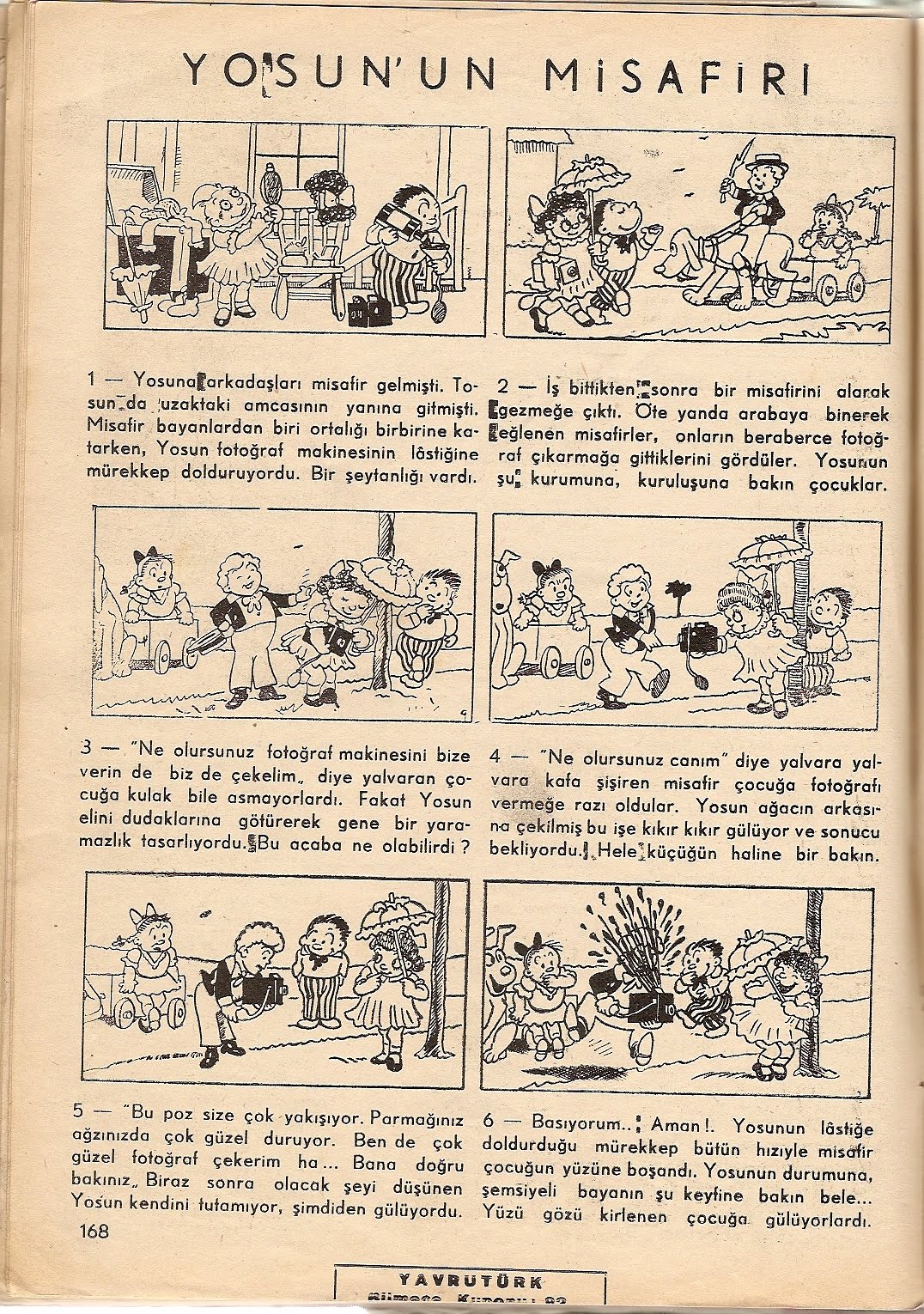
'The Katzenjammer Kids', considered by many as the first proper US comics strip, arrived in Turkey with almost a four decades delay. Above scan is of its Turkish debut in no. 66 (dated July 31st, 1937) of the weekly children's magazine Yavrutürk. Retitled as 'Tosunla Yosun [Tosun and Yosun]', the Turkish edition was traced in b&w with the speech balloons deleted from the panels and supplemented with extra-panel texts (the source of the Turkish edition might be French albums by Hachette which is known to have reprinted American strips in similar re-formatting) which is especially unfortunate as 'the Katzenjammer Kids' was one of the earliest strips to utilize speech balloons.
In 1914, 'the Katzenjammer Kids' had been cloned by its original artist Rudolph Dirks when he had lost the rights of the title to publisher Hearst in a court case: While Dirks featured the same main characters in a separate untitled strip, eventually titled as 'the Captain and the Kids', for the rival publisher Pulitzer, Hearst continued 'the Katzenjammer Kids' with a new artist, Harold Knerr. Both strips continued seperately for several decades (the Hearst version is still continuig today). The Turkish edition is of the Hearst/Knerr version as it features the supporting characters private tutor Miss Twiddle (referrred simply as "teacher" here) and her niece Lena (renamed as Fatoş and referred as the teacher's daughter), both of which were created by Knerr in 1936 and hence utilized only in the Hearst version. Yavrutürk no's 66-73 ran gag-a-week episodes of 'Tosunla Yosun', each gag being about the kids' mischiefs against their tutor and/or her niece. A five-part continuity titled as 'Tosunla Yosun Dünya Gezisinde [Tosun and Yosun in World Trip]' started in no. 74 with the kids embarking on a balloon voyage where they utilize a sea tortoise as their engine:
The second episode came in no. 76 (no 'Tosunla Yosun' page was published in no. 75, as well as in no. 77) when the kids steal away the food of a native who shoots down their balloon in revenge:
and chases them to an island:
On the island, the kids and another shipwreck rescue a baby ape:
and the island's apes help them in repairing their vehicle:
No 'Tosunla Yosun' pages were published in the next three issues of Yavrutürk after the end of this mini-adventure, but a stand-alone gag appeared in no: 84:
In 1938, several gag-a-week episodes featuring some child guests appeared, probably beginning with the below one from possibly no. 92 (the issue no. and date is missing from the tattered copy I have in my collection):
Further gag-a-week episodes with these new supporting characters appeared in no.'s 96, 97, 99 and 104 (my Yavrutürk collection from 1938 is incomplete, so a few more episodes might have been published); if anyone knows their original names, please let us know.
No 'Tosunla Yosun' pages were ran in Yavrutürk in 1939, but, inbetween three issues with color editions in back covers in 1940 (see below post in this blog), the below half-page appeared in no. 216 (dated June 1st, 1940):

FIRST COLOR EDITIONS OF THE KATZENJAMMER KIDS IN TURKEY (1940)


Above scan is of the back cover of no. 214 (dated June 1st, 1940) of the Turkish weekly children's magazine Yavrutürk, marking the first color edition of 'the Katzenjammer Kids' in Turkey. The back covers of no. 217 and 218 once again featured the Katzies, this time re-titled as 'Yosun ile Tosun ve Kaptan Baba [Yosun and Tosun with the Captain Daddy]', elevating the Captain to the title:


Thursday, March 20, 2008

PROFESSEUR NIMBUS


'Professeur Nimbus' was a wordless pre-war French comics strip created by former animator André Daix [Delachenal] in 1934. While the initial gags reportedly featured Nimbus as an inventor, his scientist career was eventually phased out even though the professor credential lingered on in the strip's title. Daix became a Nazi-collaborator during the 2nd World War and had to flee his country after the war for exile in Latin America.
Nimbus made his Turkish debut in the children's weekly magazine Yavrutürk which had started publication in 1936. He was renamed as 'Tektel Amca' (Single-hair Uncle). At least in one occasion, he was featured on the cover, which was a quite unusual practice in Yavrutürk as the magazine almost never featured any comics character on its covers. Below are a sample of Nimbus strips published in several issues of Yavrutürk in 1937:

Wednesday, March 19, 2008

FELIX THE CAT IN TURKEY

'Felix the Cat' comics, featuring the legendary silent-era animation character of the same name, first appeared in Turkey as 'Karakedi' [Blackcat] in the weekly children's magazine Yavrutürk which had began publication in 1936. Below is the back cover of the no.63, dated 10.7.1937, of v.3 of Yavrutürk featuring Felix in the Stone Age (if you click on the image, a larger-sized version will appear). If anyone can identify or estimate the original US publication date of this material, please let us know.