Tuesday, July 26, 2011

KING OF THE ROYAL MOUNTED SEES "WHAT NO WHITE MAN CAN SEE AND LIVE"


'Mystery of Little Snake', serialized in Britain's Mickey Mouse Weekly no.'s 152-161 in 1938-1939, is my most favorite 'King of the Royal Mounted' adventure. It involves the attempt of a bunch of baddies to lay their hands on a loot of gold which a tribe of natives are believed to be hiding in the secret burial ground of reserved for their chiefs. For this end, they murder the current chief of the tribe and plan to discover the secret location by trailing his son. The new chief is perfectly aware of their intentions and wisely hopes to use it as an opportunity to avenge his father... Thus, a tense journey starts as three groups, the native carrying the corpse of his father, the baddies, and King accompanied by 'kid' (the little brother of his lover) travel through the snowy terrains towards a destination unknown to all except the native to reach their fate where death is certain to meet some or all of them.
The climax is reached as the baddies follow the chief into a cave he had went in, effectively passing the point of no return in this wonderfully colored panel:
King breaks into the scene, resulting in not only a confrontation with the baddies, but a stand-of with the chief:Btw, note the artist's unfortunate blunder as King's pistol in the panel on the left above disappears on the panel on the right, only to re-appear in the panel on the left below:
Despite this artistic blunder, the face-off between King and the native is highly dramatic as both face the burden of obeying their own laws which necessiates unwillingly confronting each other.

Sunday, July 17, 2011

KING OF THE ROYAL MOUNTED AND THE CIRCUS HORRORS

The earlier adventures of King of the Royal Mounted published in Britain's Mickey Mouse Weekly (maybe I should paraphrase that as those published earlier in MMW as I cannot confirm whether the British publication followed the sequence of the adventuıres as they were originally run in the US newspapers) had a decidedly authentic tone as they often involved ordinary trappers and other locals of the Canadian countryside in their daily lives and were set in mountainous lanscapes. Eventually, the adventures took a turn in which the plots became more familiar comic-strip fare, such as 'The Terror of the Big Top' serialized in MMW no.'s 174-182 in 1939 where Sgt. King investigates a murder in a circus. The above panel is from the installement in no. 175, involving a dark, cloaked figure which had become a not-so-rare visual motif in the comics of the 1930s in the wake of The Bat Whispers (1930); below is a still from this mystery-thriller movie (whose Bat character was also an inspiration for the Batman):And the below sequence from the installement in the next issue involves the 'murder of a subject who is just about to disclose the identity of the culprit' theme so often seen in comics:The trapeze act in the below sequence from the installement in no. 178 provides an excuse for the first and only instance where some female flesh is displayed in any King of the Royal Mountain adventure that I've seen:
And the below segment from the installement in the next issue makes good opportunity of the circus setting for a tigers-set-on-loose sequence:

Saturday, July 16, 2011

KING OF THE ROYAL MOUNTED AND THE PERILS OF FILMMAKING

No, this post is not about any of the film adaptations of 'King of the Royal Mounted', but rather about an adventure in which Sgt. King, upon the request of his girlfriend Betty Blake who has taken up the job of a scriptgirl, investigates suspiciously frequent accidents occuring during the shooting of a film. Titled 'Mystery on Location', it was serialized in Britain's Mickey Mouse Weekly no.'s 183-193 in 1939 (I don't know the date of its original run in the US newspapers); the above scan is from MMW no. 187. King's suspicions zero in on none other than the director himself, as in the below sequence from no.'s 189-190 whose coloring I especially like:The relatively advanced film making equipment on display in 'Mystery on Location' suggests an early 20th century time period for the strip.
'Mystery on Location' was the last 'King of the Royal Mounted' adventure serialized in MMW during the strip's consecutive run in this British magazine in 1936-39. Initially, the adventurues carried no specific titles of their own and were run under the generic title of 'King of the Royal Mounted by Zane Grey' from the start in no. 45 till no. 99. Here are the on-print titles of the remaining adventures and the issue numbers they were carried on, and the years these issue are from:
[The Mystery of the Sunken Treasure Ship (*)] # 100-109 (1938)
The Mystery of the Rush River # 110-131 (**) (1938)
The Helium Mine Mystery # 132-141 (1938)
Trouble At Skogen Ridge Ranch # 142-151 (1938)
Mystery of Little Snake (***) # 152-161 (1938-1939)
The History of the Synthetic Diamond Formula # 162-173 (1939)
The Terror of the Big Top # 174-182 (1939)
Mystery On Location # 183-193 (1939)
The Wild Man of the Wilderness 214-22? (1940)
(*) Actually, this title was given only at the end of #99 as the title of the forthcoming adventure, but # 100-109 carried only the generic title.
(**) 'The Mystery of the Rush River' actually consists of two consecutive adventures.
(***) The opening of 'Mystery of Little Snake' refers to the preceeding adventure as 'Border Terror', so at this point, MMW apparently broke out of sequence from the strip's original run.

Saturday, July 9, 2011

'THE WILD MAN OF THE WILDERNESS'


Above scan (broken into two due to the size of my scanner), featuring the first installment of a King of the Royal Mounted adventure titled 'The Wild Man of the Wilderness', is from the color central pages of the no. 214 (dated March 9th, 1940) of Britain's Mickey Mouse Weekly. 'The Wild Man of the Wilderness' concerns a mysterious title character stealing pelts of trappers. The art is pretty good with impressive splash panels and some decent rendering of good-looking women, as in the below panels from no. 216:

I also like how the utilization of a windy and snowy setting contributes to the establishment of a moody atmosphere in the below panels from no. 219:

And below is a nice action sequence from no. 222:
I am not certain about the artist working on 'The Wild Man of the Wilderness'. The art chores of 'King of the Royal Mounted' had passed onto Jim Gary from Charles Flanders in 1939 and 'The Wild Man of the Wilderness' was serialized in MMW early in 1940, but this British magazine was probably running the American strip with some delay from its original run in the US newspapers, so its original run might have corresponded with the tenures of either Flanders or Gary.
'King of the Royal Mounted' is credited to famous Western writer Zane Grey, but Zane's byline was used for publicity purposes and the actual scriptwriter(s) of the strip are anonymous. The character is widely regarded as the brainchild of Stephen Slesinger, a literary agent who was one of the pioneers of merchandising popular literary characters. Eventually, Slesinger also conceived the idea of creating original characters and the Canadian mounted lawman King of the Royal Mounted was born. The Sunday strip kicked off in Feb. 17th, 1935 and the daily less than a year later; the original artist was Allen Dean who would eventually be replaced by Flanders. The strip would be popular enough to be adapted into the silver screen as a feature movie in 1936 and as serials in the early 1940s. It would also spin-off comics books headlining the title character who would remain in syndication till the 1950s.

Thursday, July 7, 2011

DEBUT OF BUCK RYAN (1937)


Above scan is of the first strip, dating from March 22nd, 1937, of 'Buck Ryan', a long-running British private detective serial, as reprinted in Buck Ryan volume 1: A Lady Vanishes by Newspaper Daily Comic Strip Library.
Buck Ryan was originally ran in Daily Mail, the British newspaper which pioneered British newspaper strips. Launched in 1903 by Alfred Harmsworth, the British media mogul who was also responsible for the boom of British comics magazines, Daily Mail had been running strips since 1904 including 'Mrs Hippo's Kindergarten', a historically important strip as Tiger Tim, soon to be a major British juvenile comics hero, made his first appearance there. However, the full-fledged proliferation of British strips in DM would occur in the 1930s and 'Buck Ryan' was created in that period. Writer Don Freeman and artist Jack Monk had initially created an Edgar Wallace adaptation strip, but reportedly had to to drop that one due to copyrights issues and created 'Buck Ryan' as a replacement. 'Buck Ryan' would be successful enough to run until 1962.
The first 'Buck Ryan' continuity, titled as 'A Lady Vanishes' in the reprint volume cover, has mediocre art and acceptable but undistiguished narrative about a kidnapping scheme. Visually the most interesting sequence is in the below strips:
However, the great visual potentials of an opium den setting is simply unexploited and wasted:

The same setting, on the other hand, is utilized for the utterance of some racially degrading jargon:

A noteworthy aspect of 'A Lady Vanishes' is the presence of remarkably brutal instances of violence against women, far more shocking than found in American mainstream strips of the same era as far as I am aware, one of which is in the below strip:
There are a few instances of pretty decent action sequences as well, such as the below strip:
There is also a relatively high body count:
I've also purchased vol. 9 of NDCSL's Buck Ryan reprint series and can attest that the strip had improved in terms of both art and story in two years from its inception. At some point in the future, I hope to post about that extremely interesting war-time (and war-related) continuity titled 'The Mystery of the Silent Bomber' as well. Artist Jack Monk would stay on board 'Buck Ryan' till the very end, but writer Don Freeman would eventually be replaced by others. It should be pointed out that this British comics writer (1903-72) should not be confused with an American children's books author and illustrator with the same name. The British Freeman would also contribute scripts to other leading Daily Mail strips such as 'Jane' and 'Garth'.
Newspaper Daily Comic Strip Library's reprint series appear to be computer printouts, but are quite acceptable in quality and the producers must be congragulated for the effort they put into compiling them. As I'd noted in an earlier post, these are the only available English-language reprints of Buck Ryan.

Wednesday, July 6, 2011

SMOKING MARMADUKE STRIP (1939)


Above scan of Basil Reynolds' Marmaduke strip from no. 187 (dated Sept. 2nd, 1939) of Britain's Mickey Mouse Weekly is a testament to times of a different attitude towards smoking...

Thursday, June 9, 2011

"UGH!" 'PUSSYFOOT THE REDSKIN' (1922)


Above scans are from the central pages of the no. 1653 (dated Jan. 14th, 1922) and no. 1656 (dated Feb. 4th, 1922) of the British comics magazine Comic Cuts, featuring the strip 'Pussyfoot the Redskin' by an unknown artist. It is the earliest comic strip that I've come across which headlines an American native and while the character's name might not sound flattering, it is noteworthy that he outwits the whites with his intelligence in these two samples. I cannot find any info on this interesting strip, so if anyone knows anything about it, please let us know.

Wednesday, June 8, 2011

THE COMIC CUTS COLONY


Above scan is from the back cover of the no. 1653 (dated Jan. 14th, 1922) of the British comics magazine Comic Cuts and the below one from no. 1656 (dated Feb. 4th, 1922):
According to Denis Gifford (The International Book of Comics, W H Smith Exclusive Books, London: 1988), the Comic Cuts Colony had debuted in 1894 and was created by one Frank Wilkinson, about whom I cannot find any info anywhere. While I am admittedly reluctant to speak positively about it, the art is quite high-calibre and the humour is nowhere as repugnant as similar fare from most other racial-stereotying comics.

Tuesday, June 7, 2011

PERCY COCKING IN COMIC CUTS (1922)

Recently, I had a chance to get two 1922 issues of Britain's pioneering comics magazine Comic Cuts from ebay (for an amazingly low price of app. 1 pounds each!). Comic Cuts, the first magazine to use the word "comic" in its title, was started by Alfred Harmswoth in 1890, and priced at 1/2 penny, half the price of similar magazines like Funny Folks, kicked off the boom of comics magazines in Britain. Above scan is of the cover of no. 1653 (dated Jan. 14th, 1922), featuring 'The Side-Splitting Adventures of Jolly Tom, the Merry Menagerie Man' by British comics artist Percy Cocking (1881-1964) who had been drawing the exploits of Tom in Comic Cuts since 1910. I find his art quite pleasing and high-calibre 'though the title character's twin nemesises are clearly modeled on Katzenjammer Kids. The back cover of this issue includes another strip by Cocking:

This strip is highly innovative in its utilization of the depiction of each flat as if a panel within the panels. Cocking's Mulberry Flattites had debutted in Comic Cuts in 1906. Cocking, a staffer for Harmsworth's Amalgamated Press (today's Fleetway), is better known as the artist who took over the hugely popular series 'Weary Willie and Tired Tim' created by the highly influential Tom Browne in 1896 for Illustrated Chips and continued it for more than four decades till the magazine folded in 1953.

Saturday, May 28, 2011

SKIT, SKAT AND THE CAPTAIN BY WILFRED HAUGHTON


Above scan is of a detail from the cover of no. 39 (dated Oct. 31st, 1939) of Britain's Mickey Mouse Weekly featuring the non-Disneyic comics characters Skit, Skat and the Captain created by the British comics artist Basil Reynolds for MMW alongside regular Disneyic characters in an illustration by MMW cover artist Wilfred Haugton. The full image of the cover is below:
Later in 1936, Haughton, who had been drawing the covers of MMW since its inception, also began a series titled 'The De(f)tective Agency!' featuring Goofy and Toby Tortoise as private detectives. Reynolds' characters made a cameo appearance in this series as well, in no. 50 (Jan. 16th, 1937):

Thursday, May 26, 2011

REYNOLDS' CAPTAIN IN YUGOSLAVIAN DISNEYIC COMICS (1936)


British comics artist Basil Reynolds' Captain character from his (non-Disneyic) 'Skit, Skat and the Captain' series which he drew for Britain's Mickey Mouse Weekly between 1936-1940 had made a cameo appearance in a Yugoslavian Mickey Mouse comics published in 1936: He appears in the 25th part (see above scan, taken from outducks archive) of the 'Donald & Mickey - A Trip: New Adventures' serialized in Mika Mis no.'s 32-56.
Reynolds' Captain's cameo in this Yugoslavian comics was first noticed by inducks indexer Mankkop in 2010. Actually, 'Donald & Mickey - A Trip: New Adventures', probably drawn by Yugoslavian comics artist Vlastimir Belkic, utilizes even more material from from MMW: For instance, the sea dragon which appears in part 4 is traced from a non-Disneyic gag, probably again the work of Reynolds, in MMW no. 4 and the tiger in part 19 from the 'Ted Towers' comics, of US origin, serialized in the early issues of MMW; I am sure that a patient examination would lead to identifying most of the figures in most of the panels to be traced from somewhere in MMW.

Tuesday, May 24, 2011

FIRST COLOR EDITION OF FELIX THE CAT IN TURKEY (1938)


'Felix the Cat', the biggest star of early American animation, had been adopted to the newspaper comics medium in 1923. Felix comics debutted in Turkey in the weekly children's magazine Yarutürk in 1936, retitled as 'Kara Kedi [the Black Cat]'. Published in monochrome on either the reverse of the back cover or on the back cover itself, the earliest Turkish editions of 'Kara Kedi' were reformatted with speech balloons deleted and text material added beneath the panels (scan of a sample from this period was earlier posted in this blog). 'Kara Kedi' appeared in this format in Yavrutürk till no. 125. When it resumed at the reverse of the back cover of no. 135 (dated Nov. 26th, 1938) with a new continuity titled 'Kara Kedi Gemici [Black Cat the Sailor]', it was not only in proper comics format with speech balloons and no text outside the panels, but also in color (see above scan), marking the first time a comics was published as such in Yavrutürk. Actually, I think this was the first time ever any comics was published both in color and in proper format in Turkey (there had been comics published in ull color since 1935, but they had extra-panel texts; and comics in proper format had been published since the same year, but they were in monochrome).
The first installement of 'Kara Kedi Gemici' had clearly been intended to be printed on the back cover itself, but shifted to the reverse side due to an editorial decision at the last moment to allocate the front cover to a photo of the cascet of the recently deceased Kemal Atatürk, the founder of the Turkish Republic, and shift the original front cover to the back cover. With the subsequent issue, 'Kara Kedi Gemici' took its place on the back cover:

Nevertheless, the series was shifted to interior pages with no. 143 and began to be printed in b&w, although still in proper comics format. Unfortunately, while earlier 'Kara Kedi' continuities often entailed fantasy elements and hence had very imaginative narratives, 'Kara Kedi Gemici' was a fun, but more routine affair, as exemplifed in the below cannibal sequence from no. 159:
'Kara Kedi Gemici' ended in no. 165 (dated June 24th, 1939). The subsequent four issues of Yavrutürk featured 'Kara Kedi' once again in the outmoded reformat of extra-panel texts to compansate for deleted speech balloons. Afterwards, no 'Kara Kedi' comics were published in Yavrutürk for more than two years. 'Kara Kedi' returned to Yavrutürk when the magazine started its vol. 12 with new enumeration on Oct. 25th, 1941 (previous 11 volumes had consequitive enumeration). Proper format with speech balloons and no extra-panel text was resumed with no. 28 (dated July 18th, 1942). When Yavrutürk was replaced with Çocuk Haftası from the same pulisher at the beginning of 1943, 'Kara Kedi' continued in this new childre's magazine.

Monday, May 23, 2011

OBSCURE RACIAL-STEREOTYPING COMICS


An obscure gag-a-week comics series based on degrading racial stereotyping of African blacks, titled in Turkish as 'Başkan Bambu [President Bamboo]', was ran in some issues of the Turkish weekly children's magazine Yavrutürk in 1938. Above scan is possibly of the first installement of the series (the issue no., as well as the date, are missing from the tattered copy in my collection, but it is probably no. 93). At the beginning of this gag, Bambu is introduced as "the most civilized president of the savages."
The presence of the ruling colonial forces is manifested in the below gag from no. 97:

Probably the most degrading portrayal is in the below gag from no. 98:

My Yavrutürk collection from 1938 is incomplete, but 'Başkan Bambu' was in most likelyhood published in less than ten issues.
If anyone knows the original source of this comics, please let us know...

OBSCURE TINTIN-LOOKALIKE COMICS


In 1940, an obscure adventure comics titled as 'Bücür Görünmeyen Şehirde [Shorty in the Invisible City]' was serialized in the Turkish children's weekly magazine Yavrutürk no.'s 198-208. The plot starts with a white kid who looks somewhat like Tintin, named as Bücür in this Turkish edition, befriending a native kid called Duda in Africa. The two kids come across a city in the desert where they are imprisoned for attempting to buy some food with money; for transactions with money has been forbidden in this city where everyone is obliged to give any money they find to the city's ruler. Bücür manages to escape and take a leading part in a revolt against the ruler. In the end, when he wants to embrace Duda, his friend disappears as a mirage! So does the city! In a twist, it all turns out to be a feverish dream...
If anyone knows anythig about the original source of this weird comics, PLEASE let us know..

Sunday, May 22, 2011

TURKISH DEBUT OF KATZENJAMMER KIDS


'The Katzenjammer Kids', considered by many as the first proper US comics strip, arrived in Turkey with almost a four decades delay. Above scan is of its Turkish debut in no. 66 (dated July 31st, 1937) of the weekly children's magazine Yavrutürk. Retitled as 'Tosunla Yosun [Tosun and Yosun]', the Turkish edition was traced in b&w with the speech balloons deleted from the panels and supplemented with extra-panel texts (the source of the Turkish edition might be French albums by Hachette which is known to have reprinted American strips in similar re-formatting) which is especially unfortunate as 'the Katzenjammer Kids' was one of the earliest strips to utilize speech balloons.
In 1914, 'the Katzenjammer Kids' had been cloned by its original artist Rudolph Dirks when he had lost the rights of the title to publisher Hearst in a court case: While Dirks featured the same main characters in a separate untitled strip, eventually titled as 'the Captain and the Kids', for the rival publisher Pulitzer, Hearst continued 'the Katzenjammer Kids' with a new artist, Harold Knerr. Both strips continued seperately for several decades (the Hearst version is still continuig today). The Turkish edition is of the Hearst/Knerr version as it features the supporting characters private tutor Miss Twiddle (referrred simply as "teacher" here) and her niece Lena (renamed as Fatoş and referred as the teacher's daughter), both of which were created by Knerr in 1936 and hence utilized only in the Hearst version. Yavrutürk no's 66-73 ran gag-a-week episodes of 'Tosunla Yosun', each gag being about the kids' mischiefs against their tutor and/or her niece. A five-part continuity titled as 'Tosunla Yosun Dünya Gezisinde [Tosun and Yosun in World Trip]' started in no. 74 with the kids embarking on a balloon voyage where they utilize a sea tortoise as their engine:
The second episode came in no. 76 (no 'Tosunla Yosun' page was published in no. 75, as well as in no. 77) when the kids steal away the food of a native who shoots down their balloon in revenge:
and chases them to an island:
On the island, the kids and another shipwreck rescue a baby ape:
and the island's apes help them in repairing their vehicle:
No 'Tosunla Yosun' pages were published in the next three issues of Yavrutürk after the end of this mini-adventure, but a stand-alone gag appeared in no: 84:
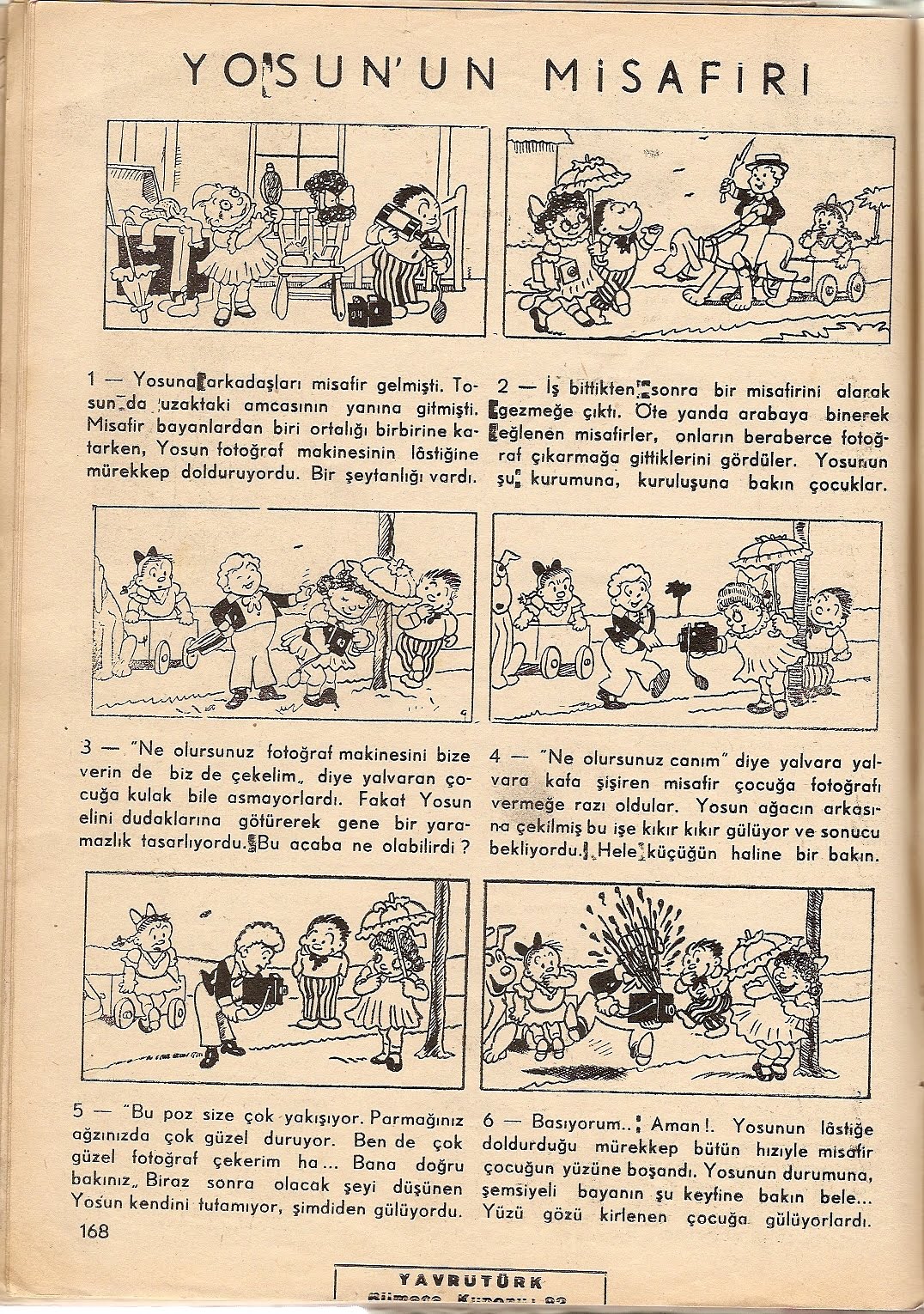
In 1938, several gag-a-week episodes featuring some child guests appeared, probably beginning with the below one from possibly no. 92 (the issue no. and date is missing from the tattered copy I have in my collection):
Further gag-a-week episodes with these new supporting characters appeared in no.'s 96, 97, 99 and 104 (my Yavrutürk collection from 1938 is incomplete, so a few more episodes might have been published); if anyone knows their original names, please let us know.
No 'Tosunla Yosun' pages were ran in Yavrutürk in 1939, but, inbetween three issues with color editions in back covers in 1940 (see below post in this blog), the below half-page appeared in no. 216 (dated June 1st, 1940):