Monday, May 23, 2011

OBSCURE RACIAL-STEREOTYPING COMICS


An obscure gag-a-week comics series based on degrading racial stereotyping of African blacks, titled in Turkish as 'Başkan Bambu [President Bamboo]', was ran in some issues of the Turkish weekly children's magazine Yavrutürk in 1938. Above scan is possibly of the first installement of the series (the issue no., as well as the date, are missing from the tattered copy in my collection, but it is probably no. 93). At the beginning of this gag, Bambu is introduced as "the most civilized president of the savages."
The presence of the ruling colonial forces is manifested in the below gag from no. 97:

Probably the most degrading portrayal is in the below gag from no. 98:

My Yavrutürk collection from 1938 is incomplete, but 'Başkan Bambu' was in most likelyhood published in less than ten issues.
If anyone knows the original source of this comics, please let us know...

OBSCURE TINTIN-LOOKALIKE COMICS


In 1940, an obscure adventure comics titled as 'Bücür Görünmeyen Şehirde [Shorty in the Invisible City]' was serialized in the Turkish children's weekly magazine Yavrutürk no.'s 198-208. The plot starts with a white kid who looks somewhat like Tintin, named as Bücür in this Turkish edition, befriending a native kid called Duda in Africa. The two kids come across a city in the desert where they are imprisoned for attempting to buy some food with money; for transactions with money has been forbidden in this city where everyone is obliged to give any money they find to the city's ruler. Bücür manages to escape and take a leading part in a revolt against the ruler. In the end, when he wants to embrace Duda, his friend disappears as a mirage! So does the city! In a twist, it all turns out to be a feverish dream...
If anyone knows anythig about the original source of this weird comics, PLEASE let us know..

Sunday, May 22, 2011

TURKISH DEBUT OF KATZENJAMMER KIDS


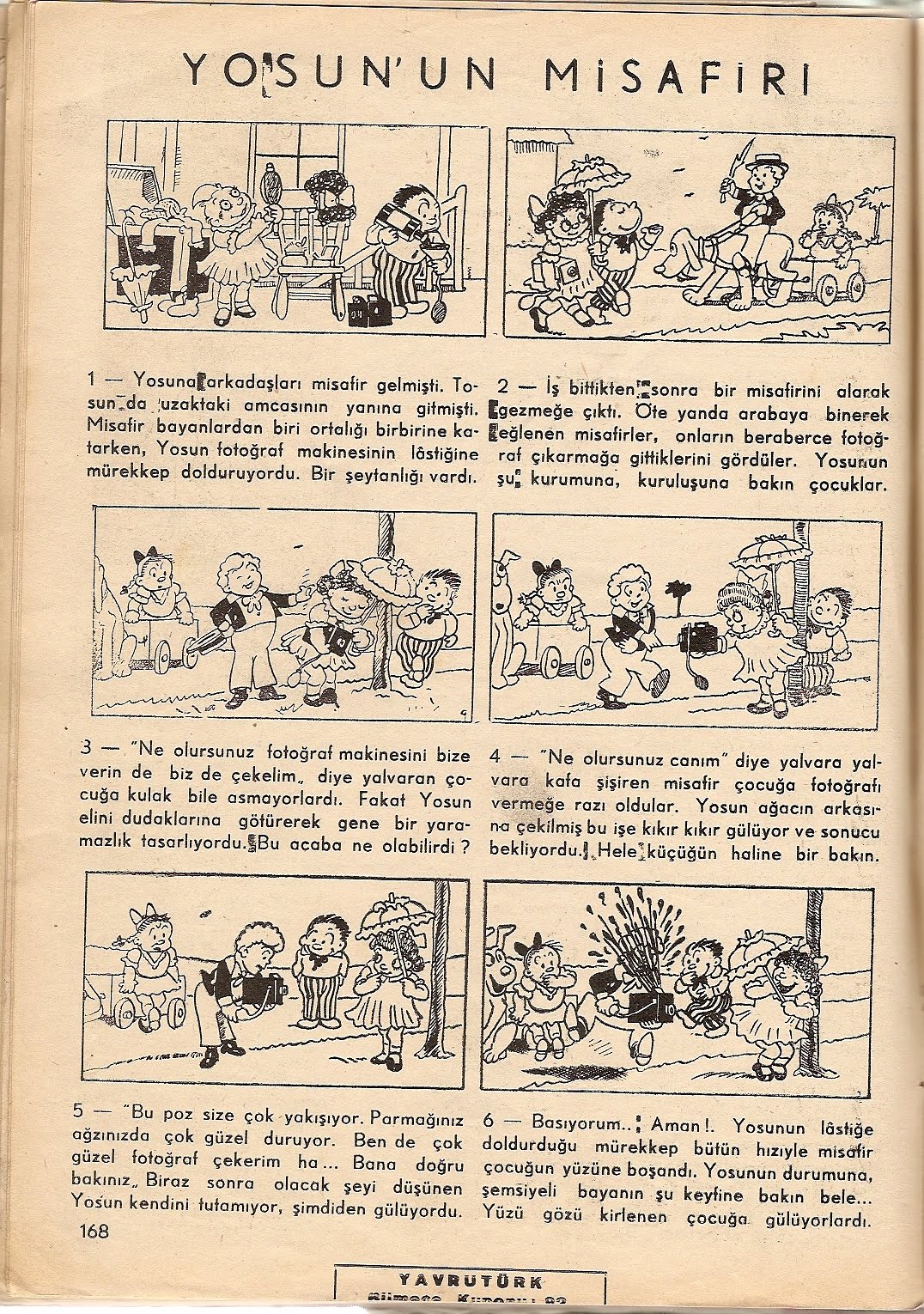
'The Katzenjammer Kids', considered by many as the first proper US comics strip, arrived in Turkey with almost a four decades delay. Above scan is of its Turkish debut in no. 66 (dated July 31st, 1937) of the weekly children's magazine Yavrutürk. Retitled as 'Tosunla Yosun [Tosun and Yosun]', the Turkish edition was traced in b&w with the speech balloons deleted from the panels and supplemented with extra-panel texts (the source of the Turkish edition might be French albums by Hachette which is known to have reprinted American strips in similar re-formatting) which is especially unfortunate as 'the Katzenjammer Kids' was one of the earliest strips to utilize speech balloons.
In 1914, 'the Katzenjammer Kids' had been cloned by its original artist Rudolph Dirks when he had lost the rights of the title to publisher Hearst in a court case: While Dirks featured the same main characters in a separate untitled strip, eventually titled as 'the Captain and the Kids', for the rival publisher Pulitzer, Hearst continued 'the Katzenjammer Kids' with a new artist, Harold Knerr. Both strips continued seperately for several decades (the Hearst version is still continuig today). The Turkish edition is of the Hearst/Knerr version as it features the supporting characters private tutor Miss Twiddle (referrred simply as "teacher" here) and her niece Lena (renamed as Fatoş and referred as the teacher's daughter), both of which were created by Knerr in 1936 and hence utilized only in the Hearst version. Yavrutürk no's 66-73 ran gag-a-week episodes of 'Tosunla Yosun', each gag being about the kids' mischiefs against their tutor and/or her niece. A five-part continuity titled as 'Tosunla Yosun Dünya Gezisinde [Tosun and Yosun in World Trip]' started in no. 74 with the kids embarking on a balloon voyage where they utilize a sea tortoise as their engine:
The second episode came in no. 76 (no 'Tosunla Yosun' page was published in no. 75, as well as in no. 77) when the kids steal away the food of a native who shoots down their balloon in revenge:
and chases them to an island:
On the island, the kids and another shipwreck rescue a baby ape:
and the island's apes help them in repairing their vehicle:
No 'Tosunla Yosun' pages were published in the next three issues of Yavrutürk after the end of this mini-adventure, but a stand-alone gag appeared in no: 84:
In 1938, several gag-a-week episodes featuring some child guests appeared, probably beginning with the below one from possibly no. 92 (the issue no. and date is missing from the tattered copy I have in my collection):
Further gag-a-week episodes with these new supporting characters appeared in no.'s 96, 97, 99 and 104 (my Yavrutürk collection from 1938 is incomplete, so a few more episodes might have been published); if anyone knows their original names, please let us know.
No 'Tosunla Yosun' pages were ran in Yavrutürk in 1939, but, inbetween three issues with color editions in back covers in 1940 (see below post in this blog), the below half-page appeared in no. 216 (dated June 1st, 1940):

FIRST COLOR EDITIONS OF THE KATZENJAMMER KIDS IN TURKEY (1940)


Above scan is of the back cover of no. 214 (dated June 1st, 1940) of the Turkish weekly children's magazine Yavrutürk, marking the first color edition of 'the Katzenjammer Kids' in Turkey. The back covers of no. 217 and 218 once again featured the Katzies, this time re-titled as 'Yosun ile Tosun ve Kaptan Baba [Yosun and Tosun with the Captain Daddy]', elevating the Captain to the title:


Saturday, May 21, 2011

KATZENJAMMER KIDS CLIPPINGS FROM 1902


These two Sunday newspaper comics clippings from 1902 (currently being offered on ebay) are the earliest samples of Rudolph Dirks' 'Katzenammer Kids' which I could find.
'Katzenammer Kids', which had debutted in 1897, is regarded as the first proper US comics (ie. structured as borderlined panels with speech balloons.

Friday, May 20, 2011

A HOODED NAZI GETS THE KICK (1943)


Miss Fury was one of the earliest masked heroines in comics - and the first one created by a female artist. June Tarpé Mills did not use her female-sounding first name when signing her work, but when Miss Fury, which debutted as a Sunday newspaper comics on April 6th, 1941, became a success, the true gender of her creater was eventually made public. Miss Fury's comics book series began in 1942 and lasted on a bi-/tri-annual period for 8 issues till 1945. You can view all the covers of this series here: http://www.comicvine.com/miss-fury-comics/49-20505/ (from which the above image was also pasted from); note that the covers of no. 4 and 5 feature evil Japanese, allies of Nazi Germany in the 2nd World War. Miss Fury comics series seem to be highly collectible items as all single issues available on ebay are offered for three- or four-digit figures!.. On the other hand, I could find one sample of the Sunday pages which indicate that the artwork was quite high-calibre:
Mills' comics work prior to 'Miss Fury' include the one-shot horror comics 'The Vampire' and the 'Daredevil Barry Flynn' series, both from Amazing Mystery Funnies*.
* Denis Gifford, The International Book of Comics (1988: W H Smith)

Tuesday, May 17, 2011

BUCK RYAN - THE ITALIAN REPRINTS

'Buck Ryan' was a detective strip published in the British newspaper Daily Mirror from 1937 onwards till 1962. During its heydays, there has been only a single one-shot Buck Ryan comics published in the UK (in 1946) and there was also an Australian Buck Ryan comics periodical. Other than what appears to be a fan-based reprint series from Newspaper Daily Comic Strip Library, there has not been any English-language reprints. However, there were some Buck Ryan albums published in Italy. The first one, in oblong format (see above image for cover) came in 1973; I don't know about its contents. Later in the same decade, the same publisher, Milano Libri Edizioni, also published a series of four albums, which appear to be hardcover editions, reprinting in chronological order from 1937 through 1940:


I've just ordered two issues of the British NDCSL reprint series and will post about them when I receive them.
Sources on the 1946 British one shot and the Australian comics: Denis Gifford, The Complete Catalogue of British Comics (1985: Webb & Bower, Exeter) and ibid, The International Book of Comics (1988: W H Smith) resp.

Tuesday, May 10, 2011

FIGHT COMICS


While researching for some other topic, I incidentally came across this startling World War 2 cover yesterday. It is no. 32 (dated June 1944) of Fight Comics published by Fiction House. Fight Comics had lasted for 86 issues between 1940-54. It was the second comics magazine put out by American publisher Fiction House who are better known with Jumbo which had featured Sheena, the first jungle girl hero in the comics medium.
Obviously encouraged by the popularity of Sheena, Fiction House had introduced a new jungle girl, named Tiger Girl, in Fight Comics no. 32 (hence the reason I went looking for this issue). Tiger Girl would also eventually be popular enough to grace the covers of most of the subsequent issues herself, one of my favorites being this later cover from no. 73 (dated March 1951):

Saturday, April 30, 2011

SKIT, SKAT AND CAPTAIN IN MICKEY MOUSE XMAS SPECIAL (1939)

One of the few excursions of Basil Reynolds' 'Skit, Skat and Captain' out of Mickey Mouse Weekly, where it had debutted (see the earlier post in this blog), would be the four Mickey Mouse holiday specials put out by the weekly's publisher Odham Press between 1936-39. The above scan is from the last of these publications, titled Mickey Mouse Xmas Special. Besides 'Skit, Skat and Captain', Reynolds also contributed two Disneyic strips to this christmas special.

MARMADUKE IN COLOR (1942) AND THE RETURN OF MARMADUKE (1947)

British comics artist Basil Reynolds, who had been on board at Britain's Mickey Mouse Weekly comics magazine since its launch in 1936, was drafted into the British army in October 1940. However, little "bits and pieces" of material he had earlier produced and un-used at the time occasionally continued to appear in the now understaffed magazine till mid-1942. A few of these were some Marmaduke strips. Unlike the original run of Marmaduke which was in black&white (see the earlier post on this blog covering the debut of Marmaduke), these extra strips were printed at the bottom rim of the back cover and hence in color. The above scan is from no. 307 (dated Apr. 11th, 1942) and the below ones from the two subsequent issues:Reynolds would return to Mickey Mouse some time after the war and would revive his mouse character, this time simply as a host, in a new b & w strip titled 'Marmaduke Presents .. ?' in 1947-48. Below samples are from no. 448 (Sept. 20th, 1947) and 451 (Nov. 1st, 1947):Pinky Green in the strip from 448 is another character Reynolds had created in 1940 for a separate strip (see the earlier post on this blog covering the debut of Pinky).

Tuesday, March 8, 2011

SUSKE EN WISKE (BOB ET BOBETTE)


'Suske en Wiske' is a Dutch-language newspaper comics serial from Belgium which had debutted in 1945 and still being run in its home country after more than half a century. The strip, created by Willy Vandersteen (1913-1990), had started on March 30th, 1945 (*) in De Nieuwe Standaard initially as 'Rikki en Wiske', chronicling the adventures of a teenage girl (Wiske) and her brother (Rikki). With the second episode ('Op het eiland Amoras') however, which started on Dec. 19th, 1945, Rikki disappeared and Wiske was joined by a male orphan named Suske and the series was re-titled accordingly. With the next episode ('De sprietatoom'), the teenage duo would be joined by the bald grown-up Lambik, a plummer by profession, who would eventually become the real attraction of the series. The strip would be popular enough to be reprinted in album format from 1946 onwards.
In 1948, Hergé, the creater of Tintin, who had launced a weekly comics magazine headlining his character, invited Vandersteen on board for its Dutch-language edition titled Kuifje. From 1950 onwards, Suske & Wiske also began to be serialized in the French-language edition (Tintin) retitled as 'Bob et Bobette'. French-language albums under this title began to be published in 1951. A total of eight 'Suske en Wiske' / 'Bob et Bobette' adventures were serialized in Kuife / Tintin till 1959. The adventures originally published in Kuife / Tintin were reprinted in albums of blue covers, distinct from newspaper strip reprint albums with red covers.
In the early 1970s, Vandersteen would hand over the strip to his assistant Paul Geertz, who ghosted for the creater until 1989 when he finaly began to be officially credited. Geertz handled the series until his retirement in 2001.
Sparodic English-language album editions of Suske en Wiske / Bob et Bobette have been published since 1976 as Willy and Wanda (US), Bob & Bobette (UK) and more recently as Spike and Suzy. For a complete list, see http://suskeenwiske.ophetwww.net/albums/engels/index-eng.php
(*) after Belgium had been liberated from the Nazi occupation, but several weeks before the war in Europe ended with the ultimate defeat and final surrender of Nazi Germany, thus making it a war-time comics, hence its inclusion in this blog
Source: http://suskeenwiske.ophetwww.net/
Coming soon in this blog:
THE TURKISH EDITIONS OF SUSKE EN WISKE / BOB ET BOBETTE

Tuesday, March 1, 2011

FANTOMAS (1941)


Historically speaking, the most important comics serialized in the wartime French comics weekly Gavroche was 'Fantômas', the first-ever comics featuring the phenomenally popular pulp fiction anti-hero of the same name which was created by French writers Marcel Allain (1885-1970) and Pierre Souvestre (1874-1914) in 1911. Between 1911-13, the duo had penned a staggering amount of 32 Fantômas novels, several of which were adapted to the screen in a series of equally succesful movies between 1913-14. In 1926, Allain would revive the character in a news series of books (Souvestre had died in 1914). Hence, the 'Fantômas' comics which kicked off in the central color pages of no. 24 (dated April 10th, 1941) of Gavroche carries a "Marcel Allain presénte" tag.
Below is the scan of the bottom two rows of the first page where Fantômas makes his first appearance (apart from the extra-panel centerfold figure seen in the above scan) in the comics as he dramatically bursts from behind a wall clock (*):

The first installement of 'Fantomas' covered both of the two central color pages:


'Fantômas' lasted till no. 30 (dated May 22d, 1941) of Gavroche and the rest of the installements beyond the first one were apparently single-page per issue, so there are a total of 8 pages. The original art work for one of the pages (**) can be seen here:
and thumbnails of all the pages and zooms of sample panels can be viewed here:
The last panel of the last installement promised a new episode titled 'Fantômas et l'enfer sous-marin [Fantomas and the underwater hell]' which was never published, presumably due to censorship.
I can't see any signatures either in the Fantômas pages of no. 24 of Gavroche which I have in my collection nor in the original art available online, but most French sources credit the art to Mat and Tori. The latter is the pen-name of Spanish-born artist Antoni Clavé (1913-2005). He was a distinguished painter in Spain who had to flee to France after the Spanish Civil War was won by the fascists. In France, he initially took up a temporary career in comics as he is known to have worked for comics weeklies Jumbo, Gavroche and Les grandes adventures. In this medium, besides 'Fantômas', he is notable for making the first comics version of Zorro in a series of albums from the Victorie collection published in Lyons, in the unoccupied regions of France, circa 1941. After the war, Clavé appears to have abandoned comics work in favor of painting and sculpture, even opening a joint exhibition with Picasso in 1946!
The identity of Mat, Tori's companion in 'Fantômas', is less clear-cut. It is tempting to identify him as the leading French comics artist Marcel Turlin (1895-1982) who used Mat as his penname. However, an online French comics dbase, la database BD du Loup, notes that Spanish emigre artist Martí Bas (1910-66) has also used the penname Mat in Gavroche. Bas, an illustrator who had produced propaganda posters for the Communist-led Republican government during the Spanish Civil War, was indeed a companion of Clavé even back in Spain where they had collaborated in stage set designs in Barcelona.
Footnotes:
(*) In a somewhat similar fashion, a female vampire appears from inside a wall clock in the French erotic horror film Les frisson des vampires (1970), directed by Jean Rollin. That scene might have been influenced by this sequence from the Fantômas comics as director Rollin was known to be a comics fan as well as part of the French surrealist circles which adored Fantômas.
(**) While the original art work of this 5th page was intended for publication in no. 28, as the pencilled note indicates, it has apparently turned out in no. 27 as no. 24 carried two pages.

Sunday, February 27, 2011

DEMONAX (1941)


Perhaps the most interesting comics series in the wartime French comics weekly Gavroche were 'Le clan des hommes oiseaux [The Clan of Bird-Men]' and its follow-up 'Les Hommes oiseaux au moyen-âge [The Bird-Men in the Middle Ages]', featuring the anti-hero Demonax, one of the earliest, perhaps the earliest anti-hero in the comics medium.
The Clan of the Bird-Men, which debutted in no. 13 (dated Jan 23rd, 1941), were a gang of masked and costumed villains with mechanical wings, led by Demonax. The second episode, which kicked off in no. 29, involves a time machine which takes the characters first to the Middle Ages, and then to the pre-historic ages, as can be seen in the above scan of the installement from no. 42 (dated August 14th, 1941). The saga ended in the next issue, which is unfortunately not available in my collection.
The original artwork of one of the earlier installements can be seen here:
http://www.comicartfans.com/GalleryPiece.asp?Piece=506191&GSub=79782 .
The series is signed by Lortac, the pen-name of the multi-talented Robert Collard (1884-1973). While his parents had intended a military career for him, Robert Collard was expelled from the French Military Academy at the age of 16 for lack of discipline. Instead, he attented painting workshops at Paris Fine Arts School and began working as an illustrator & caricaturist at newspapers in 1906. He was drafted for the 1st World War, but was discharged when he was wounded. Eventually, Collard took up an interest in animation and became one of the pioneers of this then-novel craft in France. He also penned several sci-fi and crime novels.
Demonax was Collard's first comics work. In the following years, he gave up comics art work, but became a prolific script-writer for comics. His ouvre in this category include the long-running outer space adventure comics 'Les conquerants de l'espace' serialized in Meteor between 1953-64, as well as several episodes, mostly of fantasy variety, of 'Bibi Fricotin' between 1948-69.
Main source on Lortac bio: http://www.bd-nostalgie.org/DIVERS/02_auteurs_Lortac.htm
For a detailed study of his animation work, see: http://www.pathefilm.freeserve.co.uk/95flmart/95lortac.htm

Monday, February 14, 2011

PROF. GLOBULE VS DR. VIRUS (1941-42)


'Le professeur Globule contre le docteur Virus' was one of the fantastique oriented comics published in the war-time French comics weekly Gavroche. It debutted in no. 12 and lasted till the last issue (no. 66); the above scan is from no. 42 (dated Aug. 14th, 1941). The series was signed by Erik, the pseudonym of French comics writer and artist André-René Jolly (1912-74).
Gavroche was being published in Paris which was under German occupation and the Nazi occupation authorities were controlling the distribution of paper, which was in short supply due to war conditions, in favor of pro-Nazi publications. In 1942, Gavroche had to close shop together with several other French comics weeklies due to paper scarcity. Next year, a new comics magazine titled Le Téméraire emerged to fill the void with the support of the Nazis. André-René Jolly joined the team of this Nazi propaganda vehicle and introduced a 'new' comics series very similar to his earlier Prof. Globule vs Dr. Virus one titled as 'Le docteur Fulminate et le professeur Vorax'. One significant change was the fact that the antagonist in this new series was portrayed as a Jew...
Source of the info on Le Téméraire: 'Un illustré sous l’occupation' by Gilles Ragache

Friday, February 11, 2011

KID BROWN (1941)


Beginning today, I will start covering some French-made comics published in the war-time era French comics magazine Gavroche for the next few posts. Gavroche was put out by Editions Renaudot in occupied Paris and lasted for 66 issues between 1940-42, that is in the early years of the Nazi occupation. It was one of the new comics publications which had sprang to fill the void when most of the major comics weeklies (such as Journal de Mickey) with American connection had re-located to the unoccupied southern coast of the country. It was non-political, neither pro-Resistance nor pro-Occupation.
Above scan is from no. 42 (dated Aug. 14th, 1941). The comics on this first page, 'Kid Brown, le champion', features a boxing hero. It was serialized in issues no. 31 thru no. 48. The art is by Niezab ([Gaston Niezabytowski] 1866-1955), who, after a stint at the Paris Opera as a decorator, had taken up a career initially as a magazine illustrator and then, beginning in the 1930s, as a comics artist. After 'Kid Brown' ended, another work of Niezab titled as "Criquet, gamin de Paris" started in Gavroche.
Judging by the above sample, 'Kid Brown' appears to be a rather mediocre work, but the other comics from Gavroche which I will cover in the coming posts are far more interesting, so stay tuned on..

Wednesday, February 9, 2011

THE FLOP FAMILY


'The Flop Family' is an American newspaper humour strip, featuring a middle-class family, by artist George Swanson (1897-1981, who signed the strip as "Swan") which had debutted in 1943 and was in syndication till the death of its creator. It's in the tradition of 'Bringing Up Father' and 'Blondie', but I personally find its art more alluring then both of its better-known precedents. I might be wrong, but as far as I know it has never been reprinted in any compilation. The above sample of a Sunday is from a preprint from 1950, which is currently being on ebay.
It had debutted in Turkey in 1954 in the daily newspaper Milliyet, retitled as 'Allahlık Ali Bey'. Below image is from Oct 1st from that year:
I recall that 'Allahlık Ali Bey' was still being run in Turkish newspapers in my childhood, that is 1970s. In 1982, it was revived in the multilingual magazine Hello aimed at teaching English. In the same decade, it was also ran in the comics supplement of the Bulvar newspaper.

Wednesday, December 29, 2010

ALADDIN JUNIOR

One of the non-Disneyic comics ran in Britain's Mickey Mouse comics magazine in the wartime era was 'Aladdin Jr.', chronicling the humorous exploits of a magic lamp genie accompanying a boy. 'Aladdin Junior' or alternatively 'Aladdin Jr' was an American import, a King Features Sunday newspaper comics written by Les Forgrave and drawn by William M. Prince. It had been syndicated in the US in 1942-43. According to Andy Madura's 'Comics and Paper Collectibles' site, "the story of the strip revolved around a young lad named Jack who was living the country life with his Aunt Belle and Uncle Pete. One day, his aunt breaks down and gives Jack a crate that his father had bequeathed to him. Inside was an arabian lamp, and when he rubbed the lamp a very mischevious Genie popped into Jack's life." The above scan is from MM no. 331 (dated March 13th, 1943) and the below ones from no. 358 (dated March 25th, 1944) and no. 371 (dated Sept. 23rd, 1944):